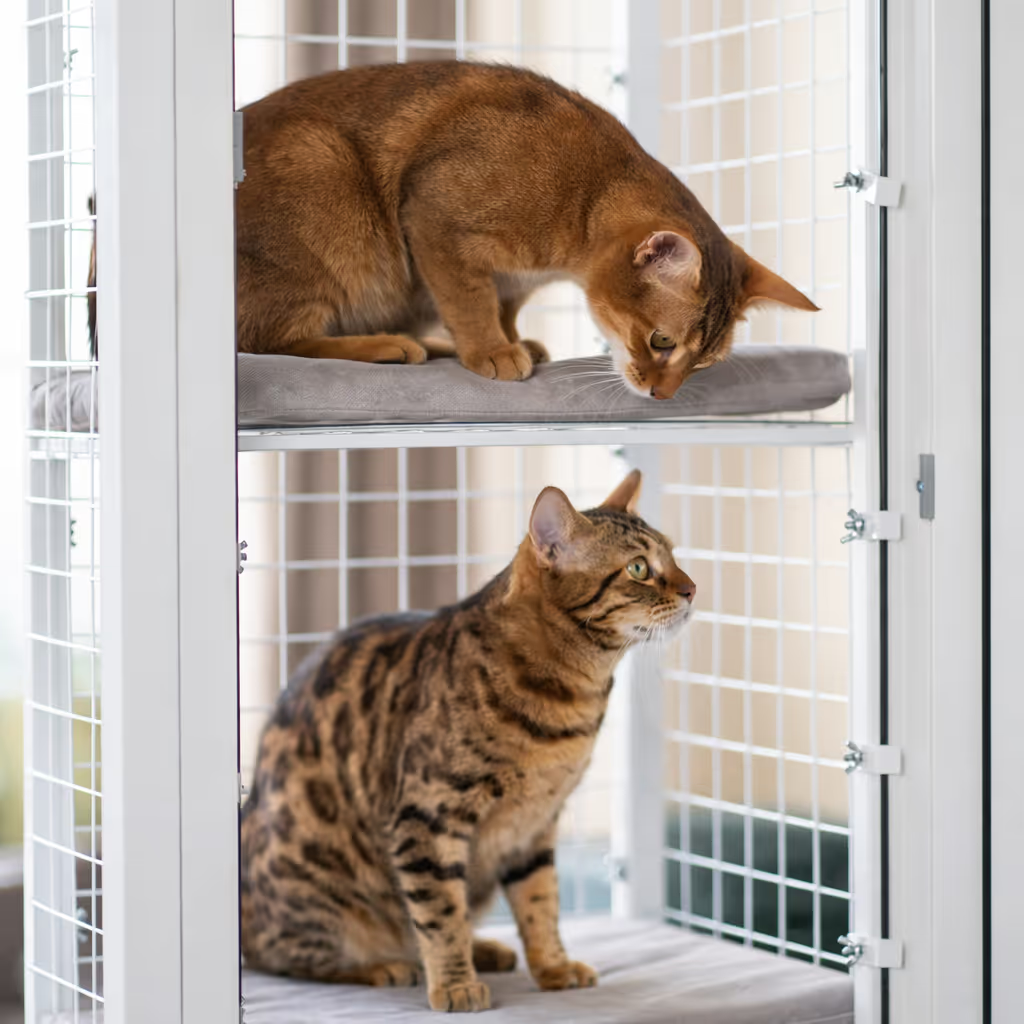
You rent, you have a cat, and you would like to open the window without worrying. The tenancy agreement says no alterations, the building has rules about the facade, and every product seems to need a drill. This guide is about that exact situation: what usually needs your landlord’s permission, which no-drill methods genuinely hold a cat and which only look like they do, how to leave the flat without a mark, and a short message you can send to ask for a written yes.
Why Drilling Is the Sticking Point
For most renters, the problem is not the cat and not the budget. It is the drill. The moment a solution needs holes in a wall, a balcony slab or a window frame, it stops being your decision and becomes your landlord’s.
There are usually three reasons for this. First, the deposit: holes, cracked render and pulled paint are among the most common things landlords deduct for when a tenancy ends. Second, the facade: in many buildings the outside of the balcony is treated as part of the building’s shared appearance, and anything visible from the street may need approval from the owner or the building management. Third, the housing association or owners’ community: in blocks of flats, balconies, railings and outer window frames are often common property, even if only you can walk on them. Your landlord may personally be fine with a net and still not be allowed to say yes on their own.
So the real question for a renter is not “how do I cat-proof my balcony?” but “how do I cat-proof it in a way that nobody can reasonably object to, and that leaves no trace when I leave?”
What Usually Needs Permission and What Usually Does Not
Rules differ from country to country, from building to building, and from one tenancy agreement to the next, so treat this as a general picture rather than advice about your flat. Read your agreement first and look for words like alterations, modifications, fixtures, facade, balcony or common parts.
Things that often need permission: anything drilled or screwed into walls, ceilings, balcony slabs or window frames; anything that changes how the building looks from outside, especially large nets or coloured structures on the facade; anything fixed to shared railings or partitions between neighbours’ balconies.
Things that often do not: furniture and planters you simply place on the balcony; freestanding items that can be picked up and carried away; removable items that do not change the building and leave no marks.
The grey zone is everything in between: clamps on railings, tension poles between floor and ceiling, clip-on mesh, window enclosures held by brackets. Many landlords are relaxed about these, some are not, and a few buildings have strict facade rules. The only safe route is to ask, and to ask in writing. A written yes protects you when the flat is inspected at the end of the tenancy, possibly by someone who never knew about the original conversation.
If your balcony door or window is a casement window, the least controversial option is often a steel cat balcony that grips the window frame without drilling, because nothing touches the wall or the facade and it comes off in one piece.
No-Drill Methods, Ranked Honestly
Every method below can be installed without holes. They are not equal. What matters for a cat is whether the method still holds when a cat jumps, pushes or hangs off it. What matters for a renter is whether it leaves marks and whether the landlord is likely to accept it.
1. Window enclosures held by brackets around the frame
This is the approach we use. Instead of fixing into the wall, steel corner brackets grip around the window frame itself, and a welded steel enclosure sits outside the open window. Nothing is drilled, nothing is glued, and the frame is left without marks when the enclosure is removed. It suits casement windows best, because the frame gives the brackets something solid to hold. The limit is that it covers the window, not the whole balcony. For many renters that is exactly the point: the cat gets fresh air and a view, and the rest of the balcony stays untouched.
2. Clip-on steel mesh on the railing or frame
Steel mesh panels held by steel clips around the railing or frame close the gaps a cat could squeeze through, without any holes. They are removable and, unlike soft netting, they do not sag or get chewed. Our Protective Mesh works this way and starts from 279€. Mesh on the railing does not stop a determined climber from going over the top, so it works best for cats who are not jumpers, or in combination with an enclosed space.
3. Clamp-on railing systems
Posts clamped to the railing hold a net or panels above it. No drilling, and usually easy to remove. The weak point is the clamp: if it can twist or slide under load, the whole system can lean outwards. Check what the clamps are made of and whether they are designed to carry a moving cat, not just the weight of the net. Railings themselves vary a lot, and thin or decorative railings may not be meant to carry extra load.
4. Tension rods and poles
Tension poles wedged between floor and ceiling are the classic answer to “tension rod catio” searches. They can hold a net in a covered balcony with a solid ceiling. They rely entirely on friction. Temperature changes, a settling floor or a cat throwing its weight against the net can loosen them over time, so they need regular checking. Protect the ceiling and floor with pads, because the pressure points can mark soft paint or tiles. They are not an option on balconies without a ceiling.
5. Freestanding catios
A freestanding enclosure placed on the balcony floor touches nothing but the floor, which makes it one of the easiest things to get approved. The trade-offs are space and wind: it takes up a large part of a small balcony, and a light frame on a high floor needs to be heavy enough, or secured without drilling, so that it cannot shift in a storm. Check that the roof is closed, because an open top is an exit.
6. Adhesive hooks and pads
Adhesive hooks are the option we would rank last. They are cheap and easy, but adhesive loses strength with heat, cold and moisture, and is not designed for the sudden load of a cat jumping into a net. They also often cause exactly the damage renters are trying to avoid: when removed, they can pull paint or render off with them. Fine for a light decoration. Not for anything your cat’s safety depends on.
What Fails Most Often
Most failures follow the same pattern. The method holds on the day it is installed, when everyone is watching, and fails months later when nobody is. Nets sag and open a gap at a corner. A tension pole loosens after a hot summer. An adhesive hook lets go on a cold night. A cable tie becomes brittle in the sun.
The second common failure is the gap nobody thought about: between the net and the wall, under the railing, at the corner where two panels meet, or at the top of a structure without a roof. Cats find these faster than people do.
The third is the landlord. A setup that was never approved can be ordered off the building halfway through a tenancy, sometimes after a neighbour complains. Asking first costs you one message.
How to Remove Everything Without a Trace
Plan your removal on the day you install. Before anything goes up, photograph the balcony, the window frame, the railing and the ceiling from several angles, with the date visible. These photos are your proof of the condition before you started.
When you move out, take things down in the reverse order you put them up. With clamp and bracket systems, loosen the fixings evenly rather than one side at a time, so nothing bends or scratches the surface. Wipe the spots where clamps or brackets sat, because dirt collected under them can look like a mark. If you used tension poles, check the ceiling and floor for pressure marks. Then photograph everything again in the same positions.
A system designed to be removed makes this easy. Our Cat Balcony is fully removable and leaves no marks on the frame, and because it is custom-measured to a window frame, it can be taken to your next flat if the window there is the same size. If it is not, send us a photo on WhatsApp and we will tell you what can be done.
A Message Template for Asking Your Landlord
Keep it short, specific and easy to say yes to. Attach a photo or product picture if you can. Adapt this to your situation:
“Hello [name], I would like to install a cat safety enclosure at the [window/balcony] of my flat at [address]. It is a removable steel structure that is held by brackets around the window frame [or: by clips on the railing], with no drilling, no glue and no changes to the walls or facade. It can be removed completely at the end of the tenancy without leaving marks, and I will restore everything to its current condition. I have attached a picture of the product. Could you please confirm in writing that this is acceptable, or let me know if the building management also needs to approve it? Thank you, [your name].”
Send it by email or through the channel your tenancy uses for official messages, and keep the reply. A short request with the no-drilling point up front is easier to approve than a long explanation.
Choosing the Right Option for a Rental
If you have casement windows and want the setup that is simplest to justify to a landlord, a window enclosure held around the frame is hard to beat: no holes, no glue, nothing on the facade walls, and it leaves with you. Our Cat Balcony starts from 899€, with the final price depending on your window size. It is built from welded galvanised steel, powder-coated in any RAL colour, tested to 40 kg static and 70 kg+ dynamic load, and weighs about 15 kg. It ships flat-packed with a video install guide, delivery within the EU is free, and we ship worldwide on quote. A mosquito-net add-on is available.
If the gap you need to close is in the railing itself, the Protective Mesh from 279€ uses steel clips on the railing or frame and comes off just as easily. And if your balcony or window does not look like any of the examples above, send us a photo on WhatsApp. It is the fastest way to find out what will actually fit, before you write to your landlord.
Built for renters: no drilling, no marks, and it moves with you when you leave. Send us your window size and we will take it from there.
get BalconyCat →