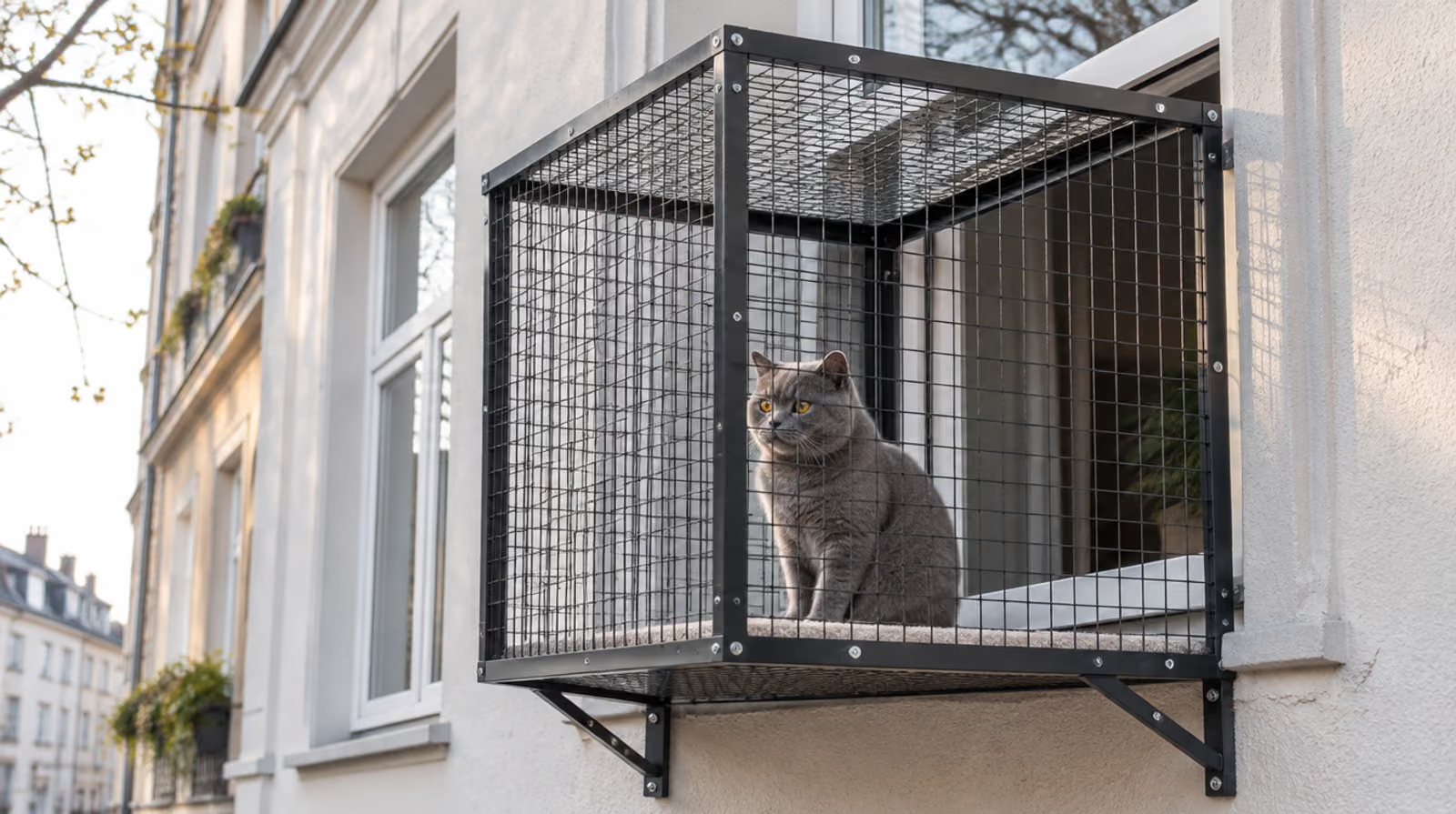
A window catio, a balcony catio and a garden catio all give an indoor cat safe time outside — but they need different amounts of space, suit different floors and leases, and cost very different amounts. This guide compares all three on the questions that actually decide it, then tells you plainly which one to choose for your home and your cat.
The Short Answer
A window catio is a small mesh box fixed outside a window, so your cat steps out through the opening and sits in fresh air with the street below. A balcony catio encloses the balcony you already have. A garden catio is a free-standing or wall-mounted run on the ground. They all do the same job — safe time outside — but they suit very different homes, budgets and cats.
If you live in a flat without a balcony, or your balcony is shared, glazed or simply too exposed, a window catio is usually the realistic choice. If you have a balcony your cat can use every day, enclosing it gives far more room for the money. If you have a garden or a ground-floor patio, a garden catio gives the most space of all, and it’s the one many people can build themselves. The rest of this guide compares the three side by side so you can match the option to your floor level, your lease and your cat.
What Each Option Actually Is
Window catio
Also called a catio window box or a cat window balcony: a welded-mesh enclosure, usually somewhere between 50 and 100 cm wide, mounted to the outside of a window. The cat goes from the sill straight into the box. Most have a solid or mesh roof, a floor panel and a shelf or two. Some are built into a sash window frame in the US style; in Europe, where tilt-and-turn and inward-opening casements are common, they’re more often clamped to the frame so the window can still swing inwards.
Balcony catio
An existing balcony closed in with mesh or netting on every side the cat can reach — railing, gaps at the wall, and often the open space above the railing up to the ceiling or a roof panel. The floor, walls and ceiling of the building do most of the work, which is why it’s usually the most space per euro.
Garden catio
A self-contained run on the ground: a timber or metal frame with mesh walls and a roof, either free-standing or fixed against the house wall, sometimes linked to a cat flap or a tunnel. Sizes range from a 1 m² lean-to to a walk-in structure of 6–10 m² or more.
For reference, the window option we make is the BalconyCat Cat Balcony, a steel window catio that clamps to the frame without drilling — we’ll come back to when it’s the right call and when it isn’t.
Window Catio vs Balcony Catio vs Garden Catio: Side by Side
Space needed
Window catio: none inside the home and none on the ground — only a window your cat can reach and a clear area of façade outside it, typically 0.3–0.6 m² of floor in the box. Balcony catio: whatever your balcony is, commonly 2–6 m² in European flats. Garden catio: from about 1 m² for a lean-to up to 10 m² or more, but it takes that space away from the garden.
Floor level
Window catio: works from the ground floor to high floors, provided it’s properly fixed and rated for the load; the higher you are, the more the fixing and the mesh matter. Balcony catio: any floor with a balcony; on upper floors every gap and the roof line need closing because falls from the second floor upwards cause real injuries. Garden catio: ground floor or a house with a garden only.
Renters and landlords
Window catio: possible in a rented flat if it clamps to the window frame rather than being screwed into the façade, and if building rules allow something visible outside. Balcony catio: the most landlord-friendly of the three when you use no-drill fixings on the railing; nothing changes the building and it all comes down when you move. Garden catio: free-standing kits are fine for most tenancies; anything fixed to the house wall or set in concrete needs permission.
Cost
Window catio: roughly 150–400€ for imported flat-pack kits, 300–600€ in materials and time if you build a solid DIY version, and roughly 700–1,200€ for a custom steel unit made to your window. Balcony catio: roughly 100–300€ for netting kits, 250–900€ for rigid steel mesh depending on the length of railing, and more if a roof panel is needed. Garden catio: roughly 200–600€ for a small timber kit, 500–1,500€ for a DIY walk-in build, and 2,000€ and up for bespoke builds.
Installation
Window catio: one window, usually an hour or two once made to measure, but it has to be done from inside without leaning out, and measuring the frame correctly is critical. Balcony catio: a weekend for netting, a day for rigid mesh panels; the slow part is closing corners and wall junctions. Garden catio: from an afternoon for a kit to several weekends for a timber build with a level base.
How much room cats actually use
Window catio: more than people expect. Most cats spend their outside time sitting, watching and dozing in one spot, so a box big enough to stretch out, turn round and sit upright is often used every day. Balcony catio: more room to pace and play, and space for a second cat, plants and a bed — but many cats still settle in the same corner with the best view. Garden catio: the most room for climbing and running, which matters for young, high-energy cats and multi-cat homes.
Maintenance
Window catio: little — wipe the mesh, check the clamps each season, keep the window seal clean. Balcony catio: netting needs checking every season and usually replacing after a few years in strong sun; steel mesh needs a clean and a look at the fixings. Garden catio: timber needs treating every year or two, roofs collect leaves, and ground-level runs need cleaning more often.
Winter
Window catio: the window has to stay open while the cat is out, so in cold months it’s short visits rather than all-day access; close the window when it’s freezing. Balcony catio: covered balconies stay usable all year, and a door left ajar loses less heat than a fully open window. Garden catio: usable if it’s linked to the house by a flap and has a dry, sheltered corner; otherwise it’s a fair-weather space.
Choose a Window Catio If…
You don’t have a balcony, or the one you have is unsuitable: shared with neighbours, fully glazed, used for storage or a bike, or so exposed that your cat would be in the full sun all afternoon. A window catio turns one window into a lookout point without changing the rest of your home.
You want your cat outside without giving up the balcony. Plenty of people use the balcony for themselves — a table, plants, drying laundry — and would rather their cat had a dedicated spot.
Your cat is a watcher rather than a runner. Older cats, calm indoor cats and cats who already spend hours on the windowsill tend to use a window box far more than owners expect, because it gives them exactly what they were doing anyway, with smells and sounds added.
You rent and drilling is out. A frame-clamped window catio leaves no holes in the façade, which is often the deciding factor in a rented flat.
One honest caveat: check your window first. The box has to sit around the opening without stopping the window from opening, and inward-opening and tilt-and-turn windows need a design made for them. If the only suitable window is a narrow top-hung pane, a window catio won’t work there.
Choose a Balcony Catio If…
You have a balcony of roughly 2 m² or more that your cat can reach through a door. Per square metre, enclosing what’s already there is almost always the cheapest way to give a cat outside space, and a netting kit fitted carefully can do the job on a tight budget.
You have more than one cat, or a young, active one. Two cats sharing a 70 cm window box will take turns; on a balcony they can both be out at once, and an agile cat has room to jump between a shelf and the floor.
You want to share the space with your cat. A catio on a balcony still works as your balcony — you can sit out with your cat around you instead of watching it through glass.
The trade-off: a balcony catio is only as safe as its weakest corner. Gaps at the wall, a railing your cat can climb over, and an open top on a top-floor balcony are where problems start, so budget for closing all of them, not just the front.
Choose a Garden Catio If…
You live on the ground floor or in a house with a garden, and you have room to give up a few square metres. A garden catio is the only one of the three where your cat can walk on grass, climb a proper frame and run a few lengths.
You like building things. Garden catios are the most DIY-friendly option: timber, galvanised mesh at 2.5 cm for kittens or up to 5 cm for adults, a roof and a level base are within reach of most people with a drill and a free weekend. That’s a real advantage over a window catio, where a home-made box several floors up is a much riskier project.
Your cat needs room. High-energy breeds, young cats and multi-cat households get the most out of space they can run in.
Watch for local rules: in some areas a large fixed structure in a garden needs permission, and in shared gardens you’ll need your neighbours on board.
Safety Differences That Matter
The three options fail in different ways. A garden catio fails gently: if a panel comes loose, your cat ends up in the garden, which is a lost cat rather than an injured one. A balcony catio fails at the gaps: corners, the space under the railing, the top edge. A window catio fails at the fixing: it’s the only one where the whole enclosure hangs on how it’s attached, so the mounting method and the load rating are the first things to check.
For any window catio above the ground floor, look for steel rather than timber, a load rating well above your cat’s weight (a cat landing from a jump puts far more force on the floor than standing still), a closed roof so the cat can’t climb out, and mesh no wider than 5 cm for adults or 2.5 cm for kittens. Ask how it attaches and what happens if the window is opened or closed while it’s fitted. If a seller can’t answer that clearly, keep looking.
Where BalconyCat Fits
We make one window catio and one mesh system, so it’s easy to say where each belongs. The BalconyCat Cat Balcony is a custom-made enclosure in galvanised, powder-coated welded steel that attaches to the window frame without drilling. It’s designed for inward-opening and tilt-and-turn windows, tested to 40 kg, and costs 899€ with free delivery across the EU (US on quote). It sits at the custom end of the window catio price range because it’s made to your window rather than a standard size.
If you have a usable balcony and a budget closer to the lower end, our Protective Mesh (from 279€) clamps to the railing and is often the better buy — and if you have a garden and like building, a DIY garden catio may beat both. We’d rather you picked the right one than the most expensive one.
FAQ
What is a window catio?
A window catio is a mesh enclosure fixed outside a window so a cat can step out and sit in the open air without being able to fall or escape. It’s sometimes called a catio window box or cat window balcony, and it’s the usual option for flats without a suitable balcony.
Is a window catio safe on a high floor?
It can be, if it’s built for it. On upper floors look for a steel frame, a closed roof, mesh of 5 cm or less (2.5 cm for kittens), a clear load rating and a fixing method that doesn’t depend on adhesive or the window staying in one position. Timber DIY boxes are better kept to the ground floor.
Can you put a catio on a balcony?
Yes — a balcony catio is simply a balcony enclosed with mesh or netting on every reachable side, including the gaps at the wall and, where needed, the open space above the railing. It’s usually the most space for the money if you already have a balcony your cat can use.
How big does a window catio need to be?
Big enough for your cat to turn round, sit upright and lie stretched out: in practice roughly 60 cm wide or more, 40–50 cm deep and 50 cm or more high for an average adult cat. Larger breeds and two cats need more, and a shelf adds useful height without adding width.
Can renters install a window catio?
Often, yes, if it clamps to the window frame instead of being screwed into the wall, and if your building doesn’t ban visible additions to the façade. Check your tenancy agreement and send your landlord a short note explaining it’s a removable safety enclosure.
How much does a catio cost?
Roughly: 150–400€ for a flat-pack window box and 700–1,200€ for a custom steel one; 100–300€ to net a balcony and 250–900€ for rigid steel mesh; 200–600€ for a small garden kit and from about 500€ for a DIY walk-in garden build. Prices vary with size, materials and whether a roof is included.
Not sure whether a window catio or your balcony is the better fit? Send us a photo of the window or balcony on WhatsApp and we’ll tell you honestly what works — the Cat Balcony window enclosure is 899€ with free EU delivery.
get BalconyCat →