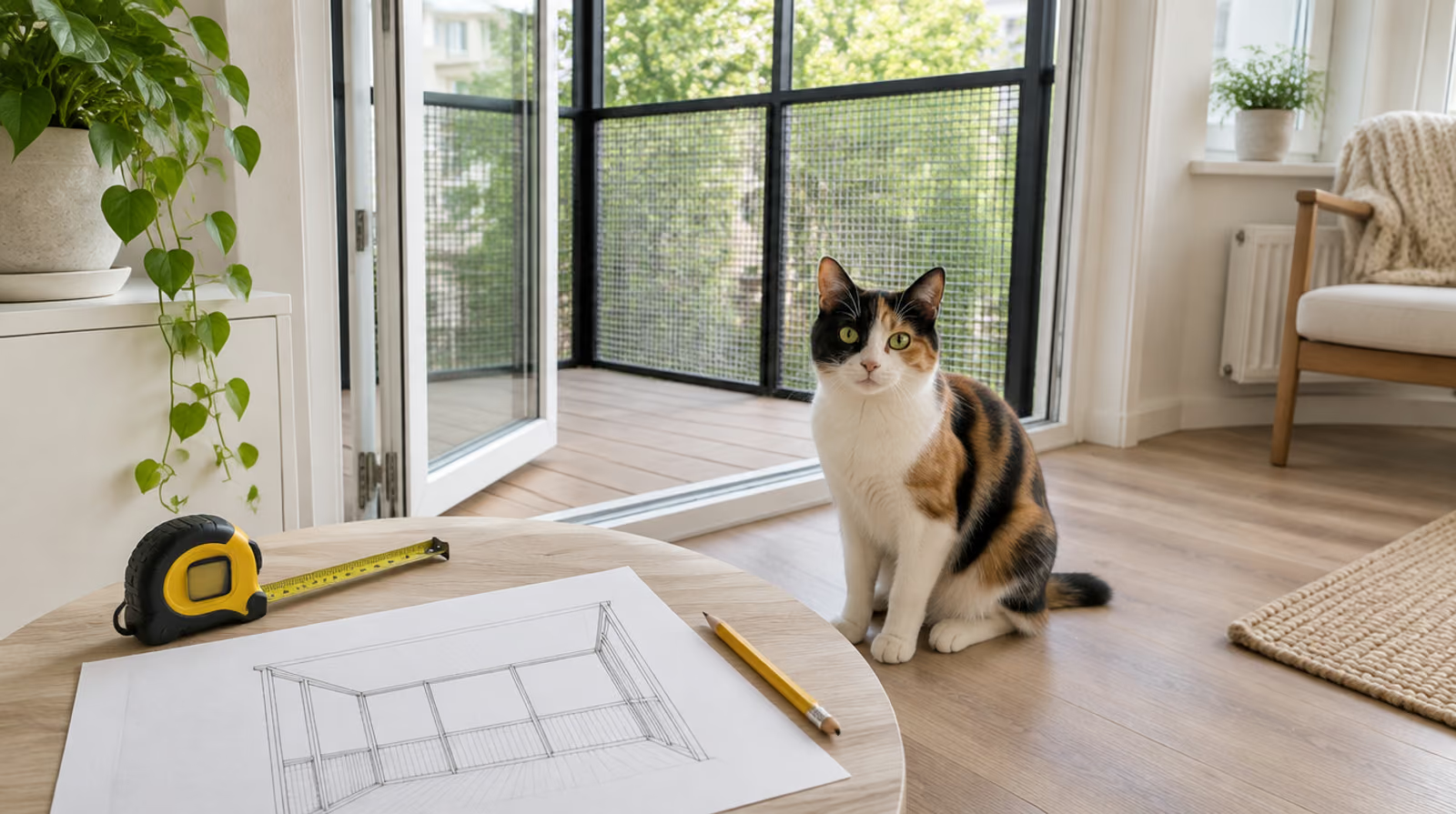
A catio kit looks like the obvious middle ground between building one from plans and paying a maker to do it — and often it is. But the real cost depends on the size of the space, the hidden extras and how long the thing lasts outdoors. Here are honest price ranges for each route, what they leave out, and how to pick a kit that’s worth the money.
The Short Answer: What a Catio Kit Costs Compared With DIY
Roughly: a catio built from plans costs the least in cash and the most in time, a flat-pack catio kit costs more but saves most of the design and cutting, and a custom-made catio costs the most because someone else measures, builds and stands behind it. For a window catio that means about 60–200€ in materials for DIY, 150–450€ for a kit and 500–1,000€ or more for custom. For a balcony, think 200–600€ DIY, 300–1,200€ for a kit and 1,200–4,000€ custom. A freestanding garden catio runs from around 400€ DIY to 8,000€ or more for a large custom build.
Those ranges are wide because size, materials and where you live move the price more than the method does. The rest of this guide breaks each route down by size, lists the costs that don’t appear on the price tag, compares wood and steel over the years you’ll actually own the thing, and finishes with a checklist for picking a catio kit that won’t let you down. We also cover when building it yourself is genuinely the better choice — because sometimes it is.
Three Ways to Get a Catio
DIY from catio plans
You buy or download a set of diy catio plans (free ones exist; paid plans are typically 15–60€), buy timber, mesh and fixings, and build it. You control every dimension, so it fits an awkward corner or an L-shaped garden perfectly. You also own every mistake: a frame that racks, a door that sticks, a mesh joint that a determined cat can lever open.
Flat-pack catio kits
A catio kit arrives as pre-cut, pre-drilled panels, usually timber frames with mesh already stapled in, plus hardware and instructions. Most catios for sale online are this type. You still assemble and anchor it, but the design work and most of the cutting are done. The catch is that kits come in fixed sizes, and your window, balcony or patio rarely matches them exactly.
Custom-made catios
A maker measures your space (or you send measurements and photos), builds to size and either ships it ready to fit or installs it. You pay for the fit, the materials and the maker’s experience with escape routes. It’s the most expensive route per square metre, and the least work.
For a sense of where custom sits at the small end, our custom-made window catio is 899€: galvanised, powder-coated welded steel, built to your window and clamped to the frame without drilling. It’s one data point, not the market average — but it shows what you’re paying for when you skip the build.
Cost by Size: Window, Balcony and Garden
These are honest, rough ranges for Europe in 2026, based on typical material prices and the kinds of products on the market. Local timber prices, delivery and VAT can push any of them up or down by a fair margin.
Window catio (roughly 0.3–0.6 m² of floor)
DIY from plans: about 60–200€ for timber or aluminium angle, a sheet of welded mesh, a small roof panel and fixings. Flat-pack kit: about 150–450€, with the cheaper end usually being lighter timber or plastic-framed boxes. Custom: about 500–1,000€ or more, depending on material and whether it has to fit an unusual window. The big variable at this size isn’t the box — it’s how it attaches. A window catio carries a cat’s full weight outside the building, so the fixing method matters more than anything else on the spec sheet.
Balcony catio (roughly 2–6 m² of enclosed space)
DIY: about 200–600€ for a frame-and-mesh enclosure on an existing balcony, more if you need a full roof. Kit: about 300–1,200€, though few kits fit balconies well because railings, ceilings and wall junctions vary so much. Custom: about 1,200–4,000€, with the top end for top-floor balconies that need a complete overhead panel. Many balcony owners spend less by meshing the existing railing rather than building a separate enclosure.
Garden catio (roughly 4–12 m² freestanding or lean-to)
DIY: about 400–1,500€ for a lean-to against the house or a freestanding run of around 2×2 m to 3×4 m. Kit: about 600–2,500€, with larger walk-in kits at the top. Custom: about 2,500–8,000€ or more for a walk-in catio with a solid roof section, shelving and a tunnel to a cat flap. At garden scale, DIY saves the most money in absolute terms, which is why so many people search for catio plans rather than catios for sale.
The Hidden Costs Nobody Puts on the Price Tag
The sticker price is rarely the final price. These are the extras that turn a 300€ kit into a 500€ project.
Tools
If you already own a drill-driver, a saw, a heavy-duty staple gun and wire cutters, DIY tools cost nothing. If you don’t, budget roughly 100–300€ for decent ones. Kits still need a drill-driver and often a spirit level; steel mesh needs proper cutters, not kitchen scissors.
Fixings and anchoring
Outdoor-rated screws, galvanised staples, mesh clips or hog rings, and ground or wall anchors add roughly 30–100€. Cheap zinc-plated screws rust within a couple of seasons and stain the timber. Ground anchors or concrete pads for a freestanding garden catio can add another 50–150€.
Roof panel
Most cats can climb an open-topped enclosure, so you need a mesh roof at minimum. If you want shade and rain cover, a polycarbonate panel costs roughly 20–40€ per m², plus glazing bars or a frame. Many kits list the roof as an optional extra, so check before comparing prices.
Wood treatment and finishing
Untreated timber needs a pet-safe exterior stain or oil: roughly 20–60€ for the first coat, then again every year or two. Factor that into the running cost, not just the build.
Permits and landlord permission
A small garden catio usually falls within the size limits for structures that don’t need a permit, but rules differ by country and municipality, and listed buildings, shared façades and homeowner associations have their own. On a balcony or window, the landlord or building management is the real gatekeeper. Getting permission costs nothing; having to remove a catio you built without it costs the whole build.
Your time
Rough build times for a reasonably handy person: a window box from plans, one weekend (6–12 hours); a balcony enclosure, two to four days; a garden catio, three to six weekends. A kit cuts that roughly in half. If your weekends are worth something to you, put a number on them before deciding DIY is cheaper.
Durability: Wood vs Steel, and Why Mesh Gauge Matters
A catio is outdoors all year, so what it’s made of decides what it really costs per year of use.
Frame material
Untreated pine, the material in many budget kits, typically lasts around 3–7 years outdoors before joints soften and screws loosen, sooner on a south-facing wall. Pressure-treated or properly maintained timber can last 10–15 years. Galvanised steel that’s also powder-coated doesn’t rot, warp or need staining, and commonly lasts well beyond that with almost no maintenance. Steel costs more up front; timber costs more in upkeep.
Mesh type and gauge
Avoid chicken wire. Its hexagonal twist is thin (often under 1 mm) and can be pushed apart or untwisted by a strong cat, and it does little to stop foxes or dogs from outside. Look for welded wire mesh of roughly 1.6–2 mm wire, ideally galvanised after welding so the joints don’t rust first. Mesh opening matters as much as thickness: around 5×5 cm suits adult cats, 2.5×2.5 cm is the safer choice for kittens and small cats. Anything wider than 5 cm is a gamble.
Joints and fixings
Most catio failures happen where mesh meets frame. Staples every 5–8 cm, a timber batten over the mesh edge, or a bolted steel frame all hold far better than staples every 20 cm. When you compare kits, look closely at how the mesh is attached, not just what it’s made of.
Resale, Moving and What Happens Next
If you rent or expect to move, a catio’s value after the first home matters. Flat-pack kits are designed to come apart, so they usually move with you, though the anchoring hardware may not suit the new place. Secondhand kits in good condition do sell, typically for a fraction of their original price, and well-kept steel holds its value better than weathered timber.
A DIY catio built to one awkward corner rarely fits anywhere else, and screwed or stapled timber doesn’t always survive being taken apart. Custom catios fit the space they were made for; if your next window or balcony is a similar size they may transfer, but measure before you assume. Whatever route you choose, a no-drill fixing method means you leave the old home without repair bills.
How to Pick a Catio Kit: A Step-by-Step Checklist
If you’ve decided a kit is the right route, work through these in order before you order.
1. Measure first, then shortlist
Measure the actual space — width, depth and height at each end — and note obstacles such as downpipes, window handles or sloping ground. Shortlist only kits that fit with room to spare, rather than ones you hope to make fit.
2. Check the mesh size and wire
Mesh opening of 5×5 cm or smaller for adults, 2.5×2.5 cm for kittens. Welded, not hexagonal. If the listing doesn’t state the wire thickness, ask.
3. Check the frame material
Look for pressure-treated timber, powder-coated aluminium or galvanised steel. Untreated pine is fine for a covered spot if you accept staining it regularly.
4. Ask how it anchors
Freestanding garden kits need ground anchors or a solid base so wind can’t shift them. Wall-mounted and window kits need a fixing method that suits your wall or frame, plus a stated load it has been tested to. If the answer is vague, treat that as the answer.
5. Confirm the roof
Is a roof included, and is it mesh, solid or both? A catio without a roof only works for cats that never climb, and you won’t know that until it’s too late.
6. Look at the door and access
You’ll need to get in to clean, so a human-sized door on walk-in catios matters. Check that it latches securely and can’t be nosed open, and that any cat-flap tunnel connects without gaps.
7. Check assembly time and weight
Realistic assembly times for kits run from about an hour for a window box to a full day or two for a walk-in garden catio. Check the parcel weight too — carrying 80 kg of panels up four flights of stairs is a cost of its own.
8. Ask about spare parts
Panels get damaged and hinges wear. A kit with spare parts available will outlast one where a single broken panel means replacing the whole thing.
When DIY Is Genuinely the Better Choice
Building your own catio from plans makes real sense if you already own the tools and enjoy the work, if your space is an odd shape that no kit fits, or if you want a large garden catio where kits get expensive per square metre. It’s also the best route when you want the catio to tie into an existing fence, shed or pergola, because no off-the-shelf product will do that cleanly.
DIY is a weaker choice for anything that hangs outside a window or sits on a high balcony. Those are the setups where a joint failing has the worst consequences, and where a tested fixing method is worth paying for. Falls from height cause real injuries in cats — vets call it high-rise syndrome — so above the ground floor, build quality isn’t somewhere to save money. On the ground, the worst outcome of a weak DIY joint is an escaped cat in the garden; three floors up, it’s a fall.
A practical middle path many people take: DIY the garden catio, buy or commission the window or balcony one.
FAQ
How much does a catio cost?
Roughly 60–1,000€ for a window catio, 200–4,000€ for a balcony catio and 400–8,000€ for a garden catio, depending on whether you build from plans, buy a kit or have one custom-made. Materials, size and whether a roof is included are the biggest variables.
Is it cheaper to build or buy a catio?
Building from plans is usually cheaper in materials, as long as you already own the tools. Once you add tools, fixings, roof panels and your time, the gap narrows considerably, especially for small window catios.
Do you need planning permission for a catio?
Small garden catios usually don’t, but limits vary by country and municipality, so check your local rules for outbuildings and attached structures. In a flat, the landlord, building management or homeowner association is the one to ask, particularly for anything visible on the façade.
What size mesh should a catio have?
Welded mesh with openings of about 5×5 cm suits adult cats; use 2.5×2.5 cm for kittens and small cats. Avoid chicken wire, which is too thin and can be pushed apart.
How long does it take to assemble a catio kit?
About an hour or two for a small window kit, half a day for a balcony enclosure and one to two days for a walk-in garden kit, assuming two people for the larger ones. Building the same size from plans typically takes about twice as long.
Are catio kits safe for balconies and windows?
Some are, but many are designed for gardens and rely on ground anchors or wall screws you can’t use on a balcony or rented window. Check the stated load rating, the fixing method and whether the kit is meant for use at height before buying.
Pricing a window catio? Send us a photo of your window on WhatsApp and we’ll confirm fit and price before anything is made. The BalconyCat Cat Balcony is 899€, custom-built in steel, no drilling, free EU delivery.
get BalconyCat →