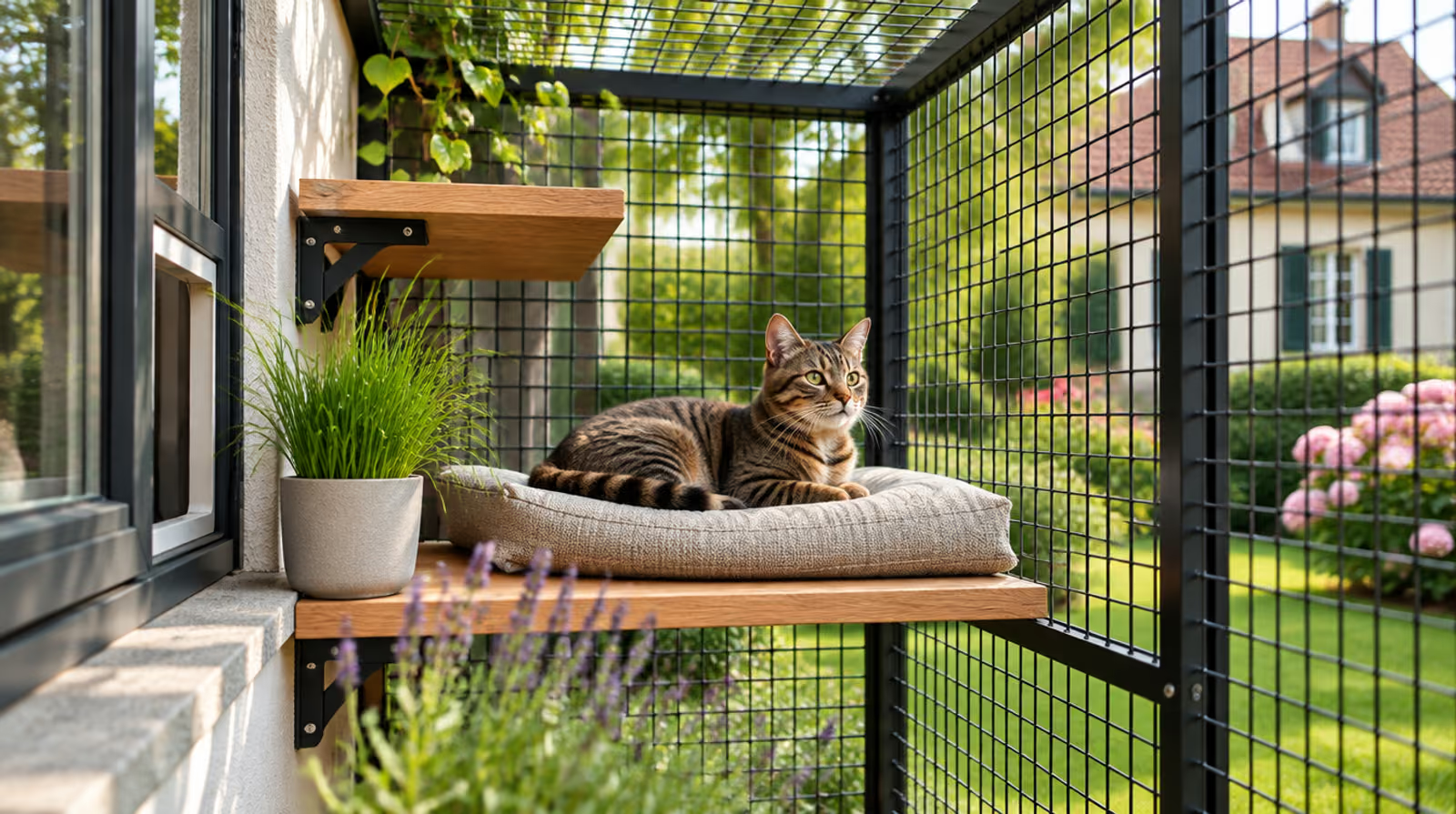
A catio is an enclosed outdoor space where a cat can enjoy fresh air safely — a patio for cats. It can be as small as a box on a window or as big as a walk-in garden room. Here’s what each type is, who it suits, what it’s made of, what it roughly costs and how to choose.
What Is a Catio? The Short Answer
A catio is an enclosed outdoor space for a cat — the name is simply “cat” plus “patio”. It’s a frame covered in mesh, open to fresh air and daylight, but closed on every side and on top, so your cat can sit outside, sniff the breeze and watch birds without being able to leave, fall or meet traffic, dogs or other cats.
That’s the whole idea. Everything else — size, materials, where it attaches — depends on your home. A catio can be a small box that fits on a window, an enclosed balcony, a walk-in garden structure, a run that leans against the house wall, or a pop-up mesh tent. This guide explains the five main types, who each one suits, what they’re made of, what they roughly cost and how to pick the right one.
Why People Build Catios
Indoor cats are safer but often bored; outdoor cats get stimulation at the cost of risk. A catio sits in the middle. Your cat gets real smells, sounds, sun and weather — the kind of input a window behind glass can’t give — while staying contained.
A catio keeps cats away from roads and away from wildlife, which matters in areas where birds and small mammals are protected. It prevents falls from windows and balconies, which vets in cities see often enough to call it high-rise syndrome. And for a cat recovering from an illness, a senior cat or an anxious one, a small outdoor space can be a calm, controlled way to get some air.
The 5 Main Types of Catio
Catios fall into five broad families. The right one is mostly decided by two questions: do you have a garden or only windows and a balcony, and do you own or rent?
1. Window catio (window box)
A compact enclosure fixed to the outside of a window, so your cat steps from the windowsill into a mesh box. Typical sizes are around 50–80 cm wide, 40–60 cm deep and 50–80 cm high — enough for a cat to sit, lie stretched out or watch the street. It’s the smallest type, but for apartments it’s often the only realistic one, and many cats use it more than people expect because it’s right next to where they already like to sit.
Our own product sits in this category — the BalconyCat Cat Balcony window enclosure is made to measure in galvanised, powder-coated welded steel and fixes to the window frame without drilling, so it works for renters with inward-opening or tilt-and-turn windows.
Best for: apartments on any floor, renters, single cats, people with no balcony or garden. Watch out for: weight limits, how it attaches, and whether your window opens in a way that lets the cat in and out.
2. Balcony catio
An existing balcony closed in with mesh on the open sides and, where needed, across the top. If the balcony above yours forms a ceiling, you may only need to enclose the railing up to that ceiling; on a top floor or an open terrace you’ll need a roof panel or net as well. Because the balcony is already there, a balcony catio gives the most space for the least structure.
Best for: flats with a balcony, owners and renters (if the fixing is removable), multi-cat homes. Watch out for: building rules about façades, gaps at the wall corners, and whether you need a roof.
3. Free-standing garden catio
A walk-in structure that stands on its own in the garden, usually on a timber or metal frame with mesh sides and a mesh or partly solid roof. Common footprints run from roughly 1.5 × 1 m up to 3 × 2 m and more, with a height of 1.8–2.2 m so a person can stand inside to clean. Some link to the house by a mesh tunnel.
Best for: houses with a garden, owners, multiple cats, people who want shelves, plants and a proper outdoor room. Watch out for: planning or neighbour rules on garden structures, a solid base, weatherproofing timber, and access from the house.
4. Lean-to or attached catio
A catio built against a house wall, so the building forms one side and often the back. This is what the cover photo shows: a steel-mesh run on the wall of a house, with shelves and plants inside. Because it shares a wall, it uses less material than a free-standing catio and it can connect directly to a window or a cat flap.
Best for: houses and ground-floor flats, owners, cats that should be able to go in and out on their own. Watch out for: fixing into the wall (usually drilling), rainwater running off the roof, and getting permission if the wall is shared.
5. Portable catio or cat tent
A lightweight mesh tent or folding playpen, usually on a fabric-and-fibreglass or light metal frame, that pops up on a lawn, terrace or balcony and packs away afterwards. It’s the cheapest way to test whether your cat enjoys being outside.
Best for: trying the idea, supervised time outside, travel, renters who can’t fix anything. Watch out for: these aren’t escape-proof for a determined cat; fabric mesh can be clawed or chewed, and a light frame can be pushed over. Treat them as supervised-use only.
Materials, Mesh and Size
Frames
Timber is the classic DIY choice: easy to cut, cheap, and it looks natural in a garden. It needs treating or painting and it will eventually weather. Steel — galvanised and ideally powder-coated — is stronger, thinner for the same strength and largely maintenance-free, which is why most window and balcony catios use it. Aluminium is light and doesn’t rust but is softer and more expensive.
Mesh
Mesh is what actually keeps the cat in, so it deserves more attention than the frame. Welded steel mesh, galvanised or coated, is the most durable option: cats can’t chew through it, sun doesn’t degrade it, and it holds its own shape. Chicken wire is cheap but thin, twisted rather than welded, and can be pushed apart — it isn’t recommended for catios. Nylon or polyester netting is light and almost invisible but needs tension to stay flat and breaks down under UV over a few seasons.
For adult cats, a mesh opening of about 5 × 5 cm is the widely used standard. For kittens and very small cats, go down to 2.5 × 2.5 cm — kittens squeeze through gaps that look impossibly small. Wire thickness matters too: around 2–3 mm is typical for a rigid welded panel. Check that coatings are non-toxic, because cats lick and chew.
Size
There’s no single right size, but some numbers help. A window catio for one cat needs enough depth to lie down fully — roughly 40 cm at the very least, 50–60 cm is more comfortable — and enough height to sit upright with room above the ears. A balcony or garden catio becomes a proper activity space once it allows a cat to jump between levels: think one or two shelves at 60–120 cm, plus a floor area for lounging.
Walk-in catios need 1.8 m or more so you can stand inside to clean, and each extra cat needs its own resting spot. Whatever the size, cats value height and a good view more than raw floor area — a vertical catio with shelves often beats a wide, flat one.
Catio Safety Checklist
Before you let your cat in for the first time, go through these points:
Fully enclosed on all sides and the top — no “it’s too high for her to jump” gaps. Mesh size correct for your smallest cat. No gaps at corners, wall junctions, around downpipes or under the bottom edge; cats test edges, not the middle of a panel. Fixings strong enough for a cat jumping onto the structure, and checked for loosening after the first few weeks. Window catios: the window can’t swing or tilt shut on the cat, and the enclosure is rated for well above your cat’s weight.
Shade and shelter: a covered corner out of direct sun and rain, and fresh water on hot days. No toxic plants — lilies are especially dangerous to cats; cat grass, catnip, valerian and lavender are popular choices, though lavender is best kept as a plant to sniff rather than one to chew. Nothing sharp: trim wire ends and cover any exposed cut edges. Supervise the first sessions and keep a quick way to get your cat back inside.
How Much Does a Catio Cost?
Prices vary widely with size, materials and how much is made to measure. As honest, rough ranges in Europe:
Portable catios and cat tents: roughly 40–200€. Cheapest entry point, best for supervised use. DIY window or balcony catio: roughly 80–400€ in timber, mesh and fixings, plus your time and tools. Off-the-shelf kits for balconies or small gardens: roughly 200–1,500€ depending on size and whether the frame is wood or metal. Custom window catios: roughly 500–1,200€; our Cat Balcony is 899€, made to measure in steel. Custom lean-to and free-standing garden catios: roughly 1,500–6,000€ and upward for large walk-in builds with roofs, doors and tunnels.
DIY is genuinely the better choice for some people: if you have a garden, basic carpentry skills and time, a timber-and-welded-mesh catio can be very good value. Where DIY tends to fall short is on windows and balconies at height, where fixings and weight-bearing matter more, and where a mistake has real consequences.
Legal and Landlord Notes
Rules vary by country, city and building, so check before you build. In rented homes, the main question is usually whether you’re allowed to drill into walls, window frames or façades — many tenancy agreements say no, which is why no-drill fixing exists. Ask your landlord in writing, explain it’s a removable safety measure for your cat, and keep photos of how things looked before.
In flats with shared ownership or a residents’ association, the façade often belongs to the building, and there may be rules on anything visible from outside, including colour. A neutral colour or one matched to your window frames helps. For garden catios, larger structures can fall under local planning or building rules, and a catio on a boundary may need a neighbour’s agreement.
How to Choose the Right Catio
Apartment, no balcony: a window catio is usually the only option, and a good one. Apartment with a balcony: a balcony catio gives your cat the most space; a window catio is the smaller, simpler alternative if the building won’t allow mesh on the balcony or you only want one opening protected. House with a garden: a lean-to or free-standing catio, depending on where you have room and whether you can fix to the wall.
Renting: look for anything that clamps, wedges or stands rather than screws into the building — window catios that grip the frame, balcony mesh that clamps to the railing, free-standing garden catios or portable tents. Owning: you have more freedom to drill and build, so attached and custom catios open up.
Then match it to your cat: climbers need a full roof and rigid mesh, kittens need finer mesh, and two or more cats need room to avoid each other, with shelves at different heights. Set a realistic budget using the ranges above, and decide honestly whether you’ll build it yourself or want it made to measure.
If you’re unsure your cat will even like being outside, a cheap portable catio for a few supervised weekends is a sensible first test. If you already know they live at the window, a permanent catio — window, balcony or garden — is the version you’ll fit once and stop worrying about. Each type has its own detailed guide in our journal.
FAQ
What is the point of a catio?
A catio gives an indoor cat safe access to fresh air, sunlight, smells and sounds without the risks of roaming — traffic, fights, getting lost or falling from a height. It adds stimulation to an indoor life and can reduce boredom-related behaviour.
Can you have a catio in an apartment?
Yes. Apartment owners and renters usually go for a window catio, which fits on a single window, or a balcony catio, which encloses an existing balcony. Both can be fixed without drilling if you choose clamp-on designs.
Do cats actually use catios?
Most do, especially if the catio is next to where they already spend time and has somewhere comfortable to lie and a good view. Some cats need a few days of curiosity before they settle; a cushion, a shelf and a few treats help.
How much does it cost to build a catio?
A DIY catio can cost roughly 80–400€ in materials, kits roughly 200–1,500€, and custom-built catios from about 500€ for a window model up to several thousand euros for a large walk-in garden structure.
Is chicken wire safe for a catio?
It isn’t recommended. Chicken wire is thin and twisted, so cats can push it apart or snag claws in it. Welded wire mesh with openings of about 5 × 5 cm, or 2.5 × 2.5 cm for kittens, is far safer and lasts longer.
Can a cat stay in a catio all day?
Only if it has shade, shelter from rain, fresh water and a way back inside. Most owners use the catio while they’re at home and close it off in very hot, cold or stormy weather, or at night.
Live in a flat and want a catio on your window? Send us a photo and your window measurements on WhatsApp and we’ll confirm fit and price before anything is made. The Cat Balcony is 899€, no drilling, free EU delivery.
get BalconyCat →