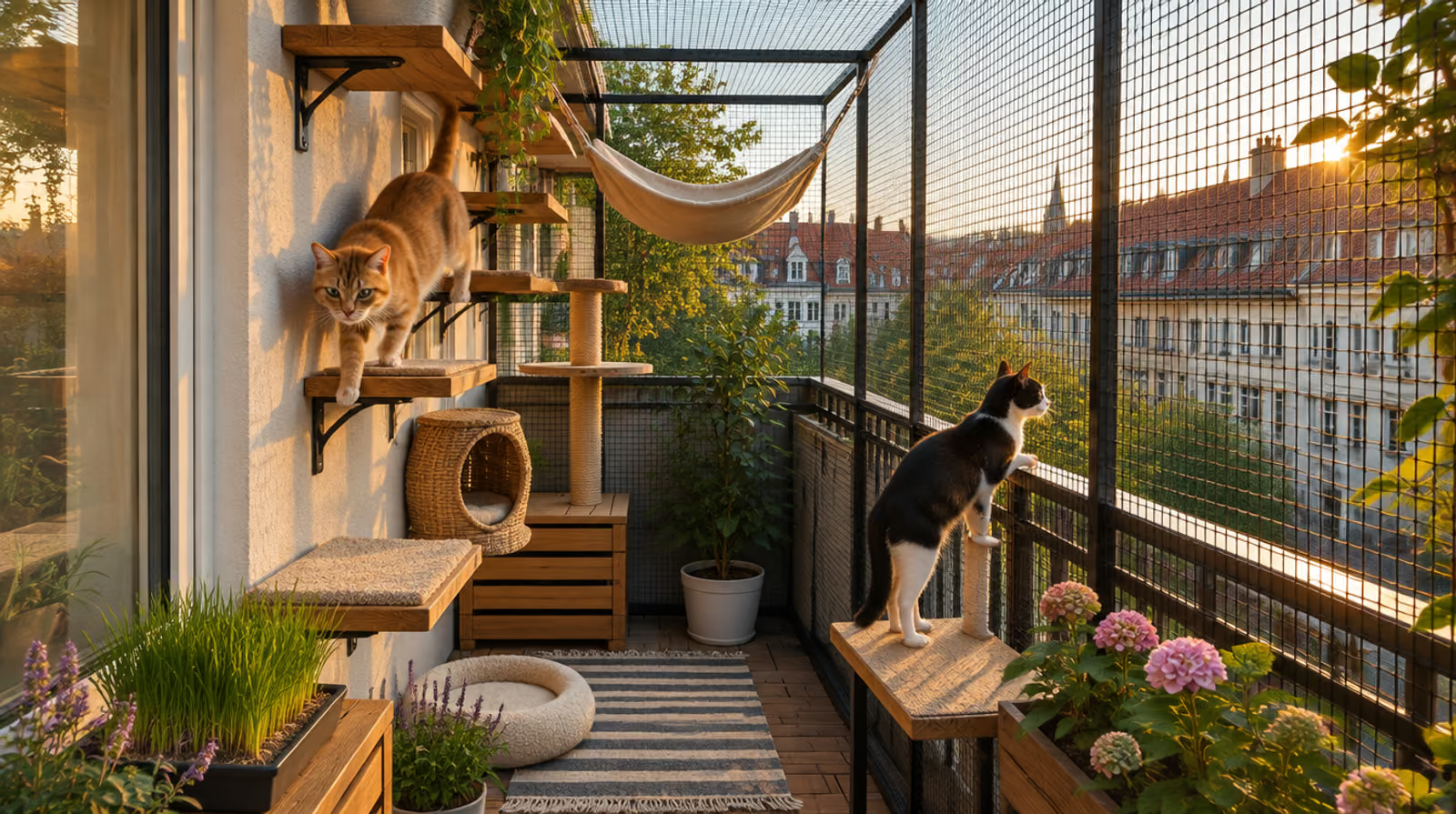
Looking for catio ideas but don’t have a garden? You don’t need one. Here are 20 ideas grouped by space — from a single window to a small balcony, a large terrace, a garden or an indoor catio — each with a rough cost, what it takes and one safety note, plus what to put inside so your cat actually uses it.
Catio Ideas for Every Kind of Space
The best catio ideas start with the space you actually have, not the one in the photos. A catio — a cat patio enclosure — can be a box on a window frame, a meshed-in balcony, a timber run in the garden or a spare room turned into an indoor catio. Below are 20 ideas grouped by space, each with a rough cost, what it takes to build or fit, and the one safety point that matters most.
Two rules apply to all of them. First, mesh size: 5×5 cm stops adult cats, 2.5×2.5 cm is the safer choice for kittens and small cats. Second, a catio is only as good as its weakest gap, so every idea here assumes a fully closed top or a roof wherever a cat could climb out. Prices are rough ranges for DIY, kits and custom builds.
Catio Ideas for a Window (No Balcony at All)
No balcony or garden? These are the smallest catios, and for many flats they’re the only option.
1. A window-mounted cat balcony
A small steel enclosure that sits outside the window frame, so your cat steps out through the open window into a meshed box with a floor and a roof. Custom units cost roughly 600–1,200€; DIY versions in timber and mesh come in around 150–350€ but need careful bracketing. What it takes: accurate window measurements and a fixing method your building allows.
This is exactly what we make — the BalconyCat Cat Balcony window enclosure is welded galvanised steel, attaches to the window frame without drilling, fits inward-opening and tilt-and-turn windows, and costs 899€ with free EU delivery.
Safety note: the enclosure must be fixed to the frame mechanically and rated for well above your cat’s weight — ours is tested to 40 kg. Never rely on suction cups or adhesive for anything a cat stands in.
2. A meshed window screen with an inside perch
If an outdoor box isn’t possible, fit rigid mesh across the opening and put a deep shelf or perch on the inside sill. The window can then stay fully open. Cost: roughly 40–120€ DIY, 150–300€ for a made-to-measure steel panel. What it takes: one opening measured to the millimetre. Safety note: insect screens are not cat screens — a cat can push through fly mesh in seconds.
3. A tilt-window guard
Tilt-and-turn windows are a known trap: cats try to squeeze through the tilted gap and get stuck. A simple side guard closes the V-shaped gap so the window can tilt for air. Cost: roughly 15–60€. What it takes: five minutes and the right size for your frame. Safety note: guards on both sides, not one — cats find the open side.
4. A window box with a sun shelf
A shallow box catio for a ground-floor or first-floor window, just big enough for one cat to lie in the sun. Cost: roughly 100–250€ DIY in exterior timber and welded mesh. What it takes: basic woodwork and a solid sill or wall below. Safety note: add a solid or meshed roof — even a small box needs one, and keep it out of the midday sun or add shade.
Small Balcony Catio Ideas
A small balcony of 2–4 m² is enough for a proper catio if you use height rather than floor space. We’ve covered build methods in our DIY balcony catio guide; these are layout ideas.
5. Full-height mesh from railing to ceiling
The classic: close the railing and the gap above it all the way to the balcony above. Cost: roughly 80–250€ for UV-stabilised netting, 400–1,200€ for rigid steel mesh cut to size. What it takes: no-drill clamps or tension poles, and an afternoon. Safety note: check the corners where the railing meets the wall — that’s where most escapes happen.
6. A corner catio
Enclose only one corner of the balcony, say 1×1.2 m, so you keep the rest for yourself. Cost: roughly 150–400€ DIY with a timber frame and mesh, more for steel. What it takes: two meshed sides, a roof and a door you can open from the balcony side. Safety note: a door needs a latch a cat can’t nudge open — a simple hook-and-eye is not enough for a determined cat.
7. A vertical climbing wall
On a narrow balcony, go up. Wall-mounted shelves at staggered heights turn a 1-metre-deep balcony into a climbing route. Cost: roughly 60–200€ for outdoor-grade shelves. What it takes: fixings into the house wall (check your lease) or a freestanding frame. Safety note: shelves must never sit near an open top edge — keep them inside a fully enclosed area so they don’t become a launch pad.
8. A balcony door screen
Fit a meshed screen door to the balcony door so the cat can be on the balcony while you have the door open, and the catio stays closed when you’re out. Cost: roughly 80–250€. What it takes: a frame measured to the doorway. Safety note: make sure your cat can always get back inside, especially in heat or a sudden storm.
Large Catio Ideas for Big Balconies and Terraces
A large catio on a terrace or a wide balcony can be a real outdoor room for you and your cat. More space means more ideas — and more surface area to secure.
9. Fully enclosed terrace with a pergola roof
Use a pergola frame as the structure and stretch mesh across the sides and top. Cost: roughly 800–2,500€ DIY, 3,000–8,000€ for a custom build depending on size. What it takes: a structure that can carry wind load and, on a roof terrace, probably building approval. Safety note: open-sky terraces need a roof — railing-height mesh alone is a climbing frame for an agile cat.
10. A walkway between two zones
Link a small enclosed area by the door to a larger one at the far end of the terrace with a meshed tunnel along the wall. Cost: roughly 200–600€ for a 3–5 m tunnel. What it takes: a modular mesh system or timber frames joined end to end. Safety note: every joint between sections is a potential gap, so overlap the mesh and fix both sides.
11. A split catio for people and cats
Divide the terrace with a mesh wall and a door: the cat gets half, you get a table on the other half, and you can sit together through the mesh. Cost: roughly 300–900€. What it takes: a single partition and a solid post at each end. Safety note: the partition must reach the roof or ceiling — a cat will climb over a 1.8 m wall.
12. A planted terrace catio
Add large planters with cat-safe plants — cat grass, catnip, valerian, spider plants — so the catio feels like a garden. Cost: roughly 100–400€ for planters and plants. What it takes: drainage and a plan for watering. Safety note: lilies are highly toxic to cats, even the pollen; check every plant before you bring it in.
Garden Catio Ideas
With a garden you can build bigger and cheaper per square metre, and DIY often makes the most sense here.
13. A lean-to catio against the house
Build against an exterior wall with access through a cat flap or a window, so the cat comes and goes on its own. Cost: roughly 400–1,500€ DIY for 3–6 m², 2,000–5,000€ professionally built. What it takes: a timber frame, welded mesh, a roof and a level base. Safety note: fit the cat flap so only your cat can use it — a microchip flap keeps out neighbours’ cats.
14. A freestanding catio run
A standalone run in the garden, often sold as a kit. Kits cost roughly 200–900€; larger DIY runs 300–1,200€. What it takes: a solid base and anchors so it can’t lift in wind. Safety note: bury mesh 20–30 cm or lay it flat under the edges so foxes or dogs can’t dig in and your cat can’t dig out.
15. Fence-top cat barriers
Instead of a box, make the whole garden the catio with inward-angled fence toppers or rollers. Cost: roughly 15–40€ per metre. What it takes: a fence in good condition with no trees or sheds to climb over. Safety note: one overhanging branch defeats the whole system, so walk the perimeter like a cat would.
16. A tunnel from the house to a run
A meshed tunnel along the ground or above the flower beds lets the cat travel from a window to a run further away. Cost: roughly 20–60€ per metre. What it takes: a tunnel at least 40 cm wide and high. Safety note: give the tunnel shade and an exit at both ends — cats don’t like dead ends in summer heat.
Indoor Catio Ideas
An indoor catio is a room or part of a room set up like an outdoor enclosure: climbing, plants, a view and fresh air through a secured window. It’s a good fit where a building bans exterior changes, or for cats that are nervous outdoors.
17. A sunroom or conservatory catio
Secure the opening windows with rigid mesh and you have a bright, airy room your cat can use all year. Cost: roughly 150–600€ for mesh on two to four windows. What it takes: measuring each opening separately. Safety note: glass rooms overheat fast — make sure there’s shade and ventilation in summer.
18. A meshed-off room corner
A floor-to-ceiling mesh partition in a spare room or a corner of the living room, with shelves and a window. Cost: roughly 150–500€ DIY. What it takes: a frame fixed to floor and ceiling. Safety note: this is useful for introductions or a recovering cat, but it shouldn’t be the only space a cat has all day.
19. A window-wall climbing route
Run shelves and steps up the wall beside your biggest window so your cat can watch the street from several heights. Cost: roughly 100–400€. What it takes: secure wall fixings rated for a jumping cat. Safety note: if the window opens, secure it with mesh before the shelves go up — not after.
20. A converted walk-in closet or box room
A small windowed room becomes a dedicated cat room with hammocks, a litter area and a meshed window that can stay open. Cost: roughly 200–700€. What it takes: a door with a gap or cat flap and good airflow. Safety note: keep cables, cords and blind strings out of reach — cats chew and tangle.
What to Put Inside a Catio
A secure catio that’s empty soon gets ignored. These are the enrichment ideas that work in any of the 20 setups above.
Shelves at height. Cats feel safest above head height. Put at least one shelf or platform at 1.2–1.8 m, and stagger the rest about 30–40 cm apart so a cat can climb without big leaps. Outdoors, use hardwood or exterior-grade timber and stainless fixings.
Cat grass and safe plants. A tray of oat or wheat grass costs a few euros and gives the cat something to chew besides your mesh. Swap it every few weeks when it goes yellow.
Hammocks. A wall- or frame-mounted hammock is a favourite lookout. Use outdoor fabric that dries quickly, and bring it in over winter.
Shade. A catio in full sun can get dangerously hot. Use a shade sail, a roof panel or plants on the sunny side, and always leave a shaded spot with water.
Rain cover. Cover at least a third of the roof with a clear polycarbonate panel or a sail so the cat can sit outside in light rain.
Litter placement. In a large catio or a garden run, a covered litter tray in a sheltered corner helps — away from food and water, and away from the main resting shelf. On a small balcony, it’s usually better to keep the tray indoors and keep the balcony for play and rest.
FAQ
What is the cheapest way to build a catio?
A small DIY catio from exterior timber and welded mesh is the cheapest, roughly 100–300€ for a window box or a balcony corner. On a balcony, UV-stabilised cat netting fixed with no-drill clamps costs roughly 80–250€, but it needs checking every season and replacing every few years.
How big should a catio be?
There’s no single rule, but for one cat aim for at least 1 m² of floor and enough height for a shelf above 1.2 m. For two cats, more floor and more shelves so each has its own spot. A window enclosure is smaller, because it’s a lookout, not a living space.
Can I put a catio on a rented balcony?
Usually yes, if nothing is drilled into the façade. Clamps on the railing or tension poles to the ceiling are removable. Check your tenancy agreement and building rules first, and let your landlord know it’s a removable safety measure.
Do catios need a roof?
If the cat can reach the top edge, yes. A balcony with a solid ceiling above already has one; an open terrace, a garden run or a window box needs a meshed or solid roof, because cats climb.
Is an indoor catio as good as an outdoor one?
It’s a good alternative, especially with a meshed window that can stay open for fresh air, smells and sounds. It won’t give the same weather and sunlight as an outdoor catio, so add a sunny spot and change things around regularly.
What mesh size is best for a catio?
5×5 cm for adult cats and 2.5×2.5 cm for kittens or very small cats. Use rigid welded mesh where a cat might chew or push, and avoid thin chicken wire, which bends and rusts.
Only have a window, or not sure which idea fits your space? Send us a photo on WhatsApp and we’ll tell you what works. The BalconyCat Cat Balcony is 899€, fits without drilling, with free EU delivery.
get BalconyCat →