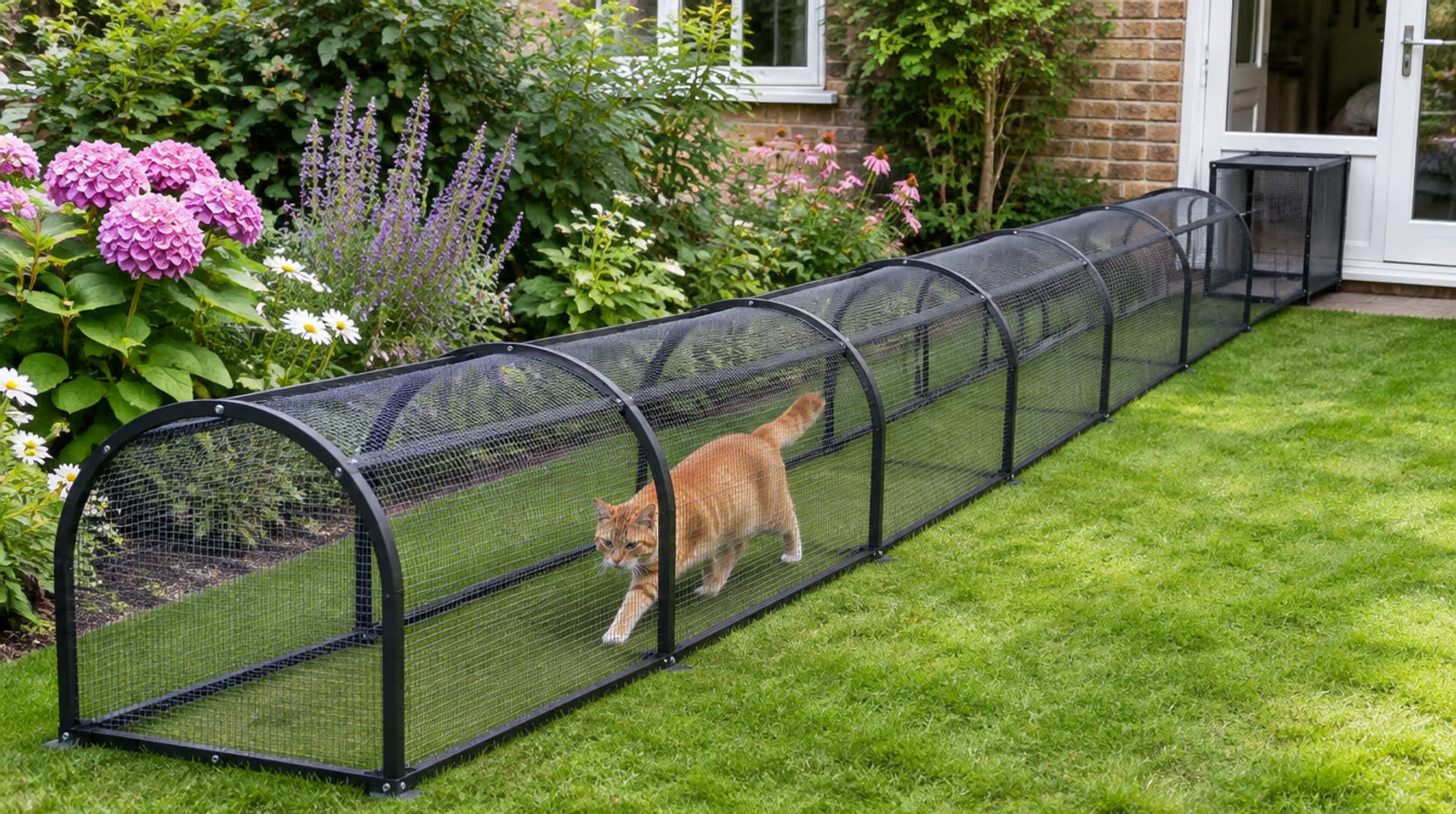
An outdoor cat run gives your cat real time outside — sun, smells, a patrol route — without roads, fights or getting lost. This guide covers when a run beats a catio or a cat-proof fence, layouts that cats actually use, sizes, materials, ground protection, winter, costs and how to get your cat to walk in.
What an Outdoor Cat Run Is — and Who It Suits
An outdoor cat run is an enclosed mesh walkway or pen in your garden or on your terrace that lets your cat be outside without being loose. It can be a low tunnel a cat walks through, a tall walk-in pen you can stand in, or a mix of both. The point is the same: fresh air, sun, smells and things to watch, with no roads, no fights with the neighbour’s tom and no getting lost.
A cat run suits indoor cats whose owners have some outdoor ground, cats that have been hurt or lost before, households on busy roads, and anyone living near wildlife they’d rather their cat didn’t hunt. It’s also the simplest option to build in stages: start with a few metres of tunnel, see how your cat takes to it, then extend. If you have no garden at all, skip to the short section on the window equivalent below — the principle carries over.
Cat Run vs Catio vs Cat-Proof Fence
These three get mixed up, and choosing the wrong one is the most expensive mistake in this area. They solve the same problem in different ways.
Cat run (including tunnels)
A long, narrow enclosure built for moving and patrolling. Cats love routes — they walk a territory rather than sit in it — and a run along a flower bed or round the lawn gives them exactly that. It takes up little ground for the distance it covers, and tunnels can be moved or taken down. The trade-off: a tunnel alone has little room for climbing, and you can’t sit in it with your cat.
Catio
A box-shaped enclosure, often attached to the house, with shelves, a roof and room to climb. Better for lounging, sunbathing and vertical space; worse for distance. Catios often cost more per square metre because they need a solid frame and roof.
Cat-proof fence
Instead of enclosing the cat, you enclose the garden: a fence at least about 1.8 m tall with an inward-angled topper or rolling bar along the top so cats can’t get over. Done well, it gives your cat the whole garden. Done badly — one gap under a gate, one tree near the boundary, one shed to jump from — it fails completely. It’s the best choice for a compact, walled garden you can fully control, and the worst for a large plot with hedges, trees or a neighbour’s extension on the boundary.
A good rule: if you can close every weak point of your boundary, a fence gives the most freedom per euro. If you can’t, a run or catio is more reliable. Many owners end up combining them — a tunnel from the house to a small catio, inside a partly cat-proofed garden.
No garden? The window equivalent
In a flat, the balcony is the garden, and the closest thing to a run is a window catio: a mesh box that sits outside a window so your cat can step out, watch the street and come back in on its own terms.
If that’s your situation, our Cat Balcony window enclosure is a welded-steel box that fixes to the window frame without drilling, fits inward-opening and tilt-and-turn windows, and is made to measure from 899€ — it does for a flat what a short run does for a house.
Cat Run Layouts That Actually Get Used
A run your cat ignores is just garden furniture. The layouts that work all share one thing: they connect to the house, so the cat chooses when to go out and when to come back.
Window-to-garden or door-to-garden tunnel
The simplest start. A tunnel runs from a cat flap in a door, wall or ground-floor window to the garden, then along a bed or fence line. Fit the flap so your cat can come and go, and the tunnel becomes part of the house rather than somewhere they’re put. On a raised ground floor, a mesh-enclosed ramp or a short stair from the window ledge does the same job.
Tunnel loops
A loop around the lawn or between beds — say 8 to 15 metres — gives a cat a patrol route with no dead end. Dead ends are where a nervous cat feels trapped, especially if another cat or a dog appears outside. If you can’t close a loop, widen the far end into a small pen where the cat can turn and sit.
Run to a catio
The most popular finished layout: a tunnel from the house to a walk-in catio or a larger pen at the end of the garden. The tunnel gives distance; the catio gives height, shelves, a roof and a place for you to sit with them. You can build the tunnel first and add the catio later.
Terrace runs
On a ground-floor terrace or patio, a run can follow the house wall: mesh panels from the paving to a roof frame or pergola, closing off a strip a metre or so deep. Watch for gaps where paving meets lawn, and for drainpipes and window sills cats can use as ladders.
How Big Should a Cat Run Be?
There’s no official standard, but these working figures hold up.
Tunnels: a cross-section of about 40 × 40 cm is the minimum for a small or average cat to walk comfortably; 50–60 cm is better, and large breeds such as Maine Coons need the bigger end so they can turn round without squeezing. Every few metres, add a wider section or a box where the cat can sit, turn and look out.
Walk-in runs: aim for a height of about 1.8–2 m so you can stand inside to clean and play. For floor area, roughly 2–3 m² per cat is a sensible minimum for a pen, with more needed if it’s the cat’s only outdoor space. Two cats need more than double, because they need room to avoid each other, not just to fit.
Length: for a tunnel, longer is almost always better. A 3 m tunnel is a corridor; a 10 m tunnel is a territory. If space is tight, go up rather than out — shelves and a raised walkway in a pen add usable space without adding ground.
Building It: Ground, Mesh, Panels and Toppers
Ground and digging protection
Cats rarely dig out, but foxes and dogs can dig in, and a loose bottom edge is where a determined cat will push under. Options, from simplest to strongest: pin the bottom edge flat with ground pegs every 30–50 cm; lay a mesh apron 30–50 cm wide flat on the ground outwards and let the grass grow through it; bury a mesh skirt about 30 cm deep; or build on a paving or gravel strip so there’s nothing soft to dig. Under a walk-in run, a mesh floor beneath bark or soil also stops tunnelling from outside.
Mesh tunnels
Ready-made tunnels are usually fabric-and-mesh tubes on spring-steel or plastic hoops. They’re light, cheap and quick to set up, and fine for supervised use or a calm cat. They don’t like strong UV, heavy snow or claws, so expect to replace them every few seasons. DIY tunnels made from welded wire mesh bent over a timber base are sturdier; use galvanised or coated mesh, roughly 2.5–5 cm openings (2.5 cm for kittens and if you want to keep small predators out), with smooth cut edges filed or capped.
Steel and timber panels
For permanent runs and catios, welded steel mesh panels on a timber or steel frame are the long-term option. Galvanised, powder-coated steel doesn’t rot, can’t be chewed and doesn’t sag. Avoid thin chicken wire — the twisted hexagonal kind — for anything permanent: it deforms when pushed and foxes can tear it. Wire of about 1.6–2 mm thickness is a reasonable floor for welded panels. Treat timber against rot, and keep the mesh on the inside face of the frame where possible so a cat can’t climb the posts.
Fence toppers
For a cat-proof fence, toppers come in three main types: angled mesh or net brackets that lean 45° or so into the garden, rolling bars that spin when a cat grabs them, and flexible netting extensions. Angled brackets of 50–60 cm on a fence of about 1.8 m are a common setup. Toppers work only if the whole boundary is covered — gates, trees, sheds and walls included.
Weather, Winter, Predators and Neighbours
Sun and rain
Every run needs shade and a dry corner. A tunnel across an open lawn in July can get uncomfortably hot, so route it past shrubs or cover part of the roof with shade cloth or a clear panel. Always leave water in a walk-in run, and never shut a cat in a run with no way back indoors.
Winter
Fabric tunnels may need to come down in heavy snow, because snow load flattens them. Mesh roofs on catios can collect heavy, wet snow too, so a pitched or partly solid roof helps. Check fixings and the bottom edge after storms and thaw, when ground pegs loosen. A cat flap with a draught seal keeps the house warm while the run stays open.
Predators
In Europe the main visitors are foxes, dogs, stray cats and, for very small kittens, large birds of prey; in parts of North America, coyotes too. A fully roofed run with welded mesh and a secured bottom edge keeps them out. A cat-proof fence keeps your cat in but doesn’t always keep wildlife out, which is worth thinking about if you leave your cat in the garden at dusk.
Neighbours and local rules
Check local planning or building rules before you build tall: in many places, boundary structures over roughly 2 m need permission, and listed buildings or shared gardens have their own rules. Keep runs a little away from the boundary so your cat can’t sit on the neighbour’s side of the fence, and talk to the neighbours before a catio goes up against a shared wall.
What an Outdoor Cat Run Costs
Prices vary widely by country and finish, so treat these as rough ranges rather than quotes.
DIY tunnel from mesh and timber: roughly 10–30€ per metre in materials, plus your weekend. Ready-made fabric or mesh tunnel kits: roughly 30–150€ for a few metres, more with connectors and pens. Modular steel or timber run kits: roughly 300–1,500€, depending on size and quality. Made-to-measure runs and catios by a carpenter or installer: roughly 1,500–6,000€, and more for large or complex builds. Cat-proof fence toppers: roughly 15–40€ per metre for bracket-and-net kits, more for rolling bar systems, before labour.
DIY is genuinely the better choice for many gardens: a simple welded-mesh tunnel built well will outlast a cheap kit. Pay for custom work when the run joins the house, carries a roof, or needs to look good from the street.
How to Train Your Cat to Use the Run
Most cats take to a run quickly; some need a week or two. Go at the cat’s pace.
Start by letting them watch the run from indoors for a few days. Then prop the cat flap or door open, put treats and a familiar blanket just inside the entrance, and stay nearby. Keep first sessions short — five or ten minutes — and let your cat leave whenever they want. In a walk-in run, sit inside with them, play with a wand toy and feed a meal there. Once they’re relaxed, teach the flap: hold it open, then lift it a little, then let them push it themselves.
Don’t carry a nervous cat into the run and leave them there, and don’t close the route back indoors until they treat the run as theirs. Add interest over time: a shelf, a scratching post, cat grass in a pot, a log to sniff. A run that changes a little now and then gets visited more.
FAQ
Are cat runs cruel?
No — a well-designed run gives an indoor cat more stimulation, exercise and sun than staying inside, without the risks of roaming. What makes a run unkind is poor design: no shade, no water, too small, or no way back into the house.
How big should an outdoor cat run be?
For tunnels, aim for a cross-section of at least 40 × 40 cm, ideally 50–60 cm, and as long as your garden allows. For a walk-in pen, roughly 2–3 m² per cat and about 1.8–2 m high is a practical minimum.
Can cats dig out of a cat run?
It’s uncommon, but cats will push under a loose bottom edge, and foxes can dig in. Pin the edge every 30–50 cm, or lay or bury a mesh skirt about 30 cm wide or deep.
Do cat tunnels work in winter?
Yes, with care. Steel or welded-mesh tunnels stay up all year; fabric tunnels may need taking down in heavy snow. Keep a covered, dry section and a cat flap so your cat can come in whenever they want.
Is a cat-proof fence better than a cat run?
It gives more freedom if you can close every weak point — gates, trees, sheds and walls. If your boundary has gaps you can’t fix, a roofed run or catio is more reliable.
Can I have a cat run if I live in a flat?
Not in the garden sense, but a window catio gives the same idea on a smaller scale: a mesh box outside a window the cat can use on its own. An enclosed balcony is the other option.
No garden, just a window? Send us a photo and your window measurements on WhatsApp and we’ll tell you whether the Cat Balcony window enclosure fits — made to measure from 899€, no drilling, free EU delivery.
get BalconyCat →