An outdoor cat enclosure gives your cat sun, air and something to watch without roads, fights or escape routes. There are six main types, from a window box to a garden catio, and they differ in space, cost, permanence and how much supervision they need. This guide compares them so you can pick the one that fits your home.
What Counts as an Outdoor Cat Enclosure
An outdoor cat enclosure is any mesh-and-frame structure that lets a cat sit in fresh air, sun and wind without being able to leave or be reached by anything else. The range is wide: a small box bolted outside a window, a closed-in balcony, a walk-in garden catio, a long tunnel, a pop-up tent or a rigid cage. They all do the same job, and they differ mainly in space needed, cost, permanence and how much supervision they expect from you.
The right choice depends on what you actually have: a window, a balcony, a patio or a lawn. This guide compares the six main types side by side, with honest cost ranges, so you can match the enclosure to your home rather than the other way round.
The Six Types at a Glance
Think of the types as a ladder from small and cheap to large and permanent. Prices are rough European ranges for materials or kits, not quotes, and vary by country and finish.
Window box: roughly 0.3–1 m² of floor, mounted outside a window. About 100–900€. Semi-permanent. Safe unsupervised if built from steel. Balcony enclosure: covers an existing balcony, from about 2 m² upwards. Roughly 300–3,000€ depending on net or steel. Permanent or semi-permanent, usually unsupervised once secure. Garden catio: walk-in, typically 3–10 m² or more. Roughly 400–6,000€. Permanent. Unsupervised if roofed and secured at the base.
Cat run or tunnel: narrow, often 5–15 m long. Roughly 30–1,500€ for kits, more if custom. Permanent or removable. Unsupervised if steel mesh, supervised if fabric. Cat tent or portable catio: roughly 1–3 m², folds away. Typically 30–200€. Temporary. Supervised, always. Cage: a rigid freestanding unit, about 1–4 m². Roughly 100–800€. Semi-permanent. Unsupervised only if it is strong, roofed and on a solid base.
The rest of this guide goes through each one, then ends with a short decision guide.
Window Box and Window Enclosure
A window enclosure is a mesh box fixed to the outside of a window frame so the cat steps from the sill into a protected space. It is the smallest permanent option and the only real one for a flat with no balcony. Floor area is modest, usually between 0.3 and 1 m², so it works as a lookout and a place to sunbathe rather than a place to run.
If you rent or own a flat with inward-opening windows, our Cat Balcony window enclosure is a welded-steel box that fixes to the window frame without drilling, is tested to 40 kg and is made to measure from 899€, with free delivery in the EU.
Cheaper window boxes exist. Light plastic-coated frames or fabric boxes that hook over the sill cost roughly 100–300€, but they are best used with you nearby, because thin frames flex under a heavy or determined cat. Steel units cost more and are meant to be left alone.
What to check before buying: how your window opens (inward-opening and tilt-and-turn suit most box designs; sliding and outward-opening windows are harder), what the frame is made of, and whether the building owner allows it. Reversible, no-drill fixing makes the last question much easier for tenants.
Balcony Enclosure
A balcony enclosure turns an existing balcony into a safe outdoor room. You close the open sides and, where it makes sense, the top, with netting or rigid mesh. The floor space is already there, which is why this is often the best value per square metre of any enclosure type: the cat gets 2 to 8 m² of outdoor space for the cost of the barrier alone.
There are two main routes. Cat netting, typically with 3 × 3 cm or smaller mesh, stretched between anchor points, costs roughly 300–900€ installed or 50–200€ if you fit it yourself. It is light, nearly invisible and fine for lower floors with careful installation, but it needs regular checks for UV wear, loose knots and gaps at corners. Rigid welded steel mesh, with openings of about 2.5–5 cm, costs more, roughly 1,000–3,000€ custom, but doesn’t stretch, can’t be chewed and holds up in wind, snow and heat for years.
Whichever you choose, the weak points are always at the edges: where the barrier meets the wall, the railing, the ceiling above and any gap beside a drainpipe. A balcony enclosure is only as safe as its smallest gap. If you rent, check what the lease says about fixings before drilling; clamp-on and non-drilling systems exist for exactly this reason.
Garden Catio
A garden catio is the classic walk-in structure: a frame covered in mesh, with a roof, shelves, ramps and a door you can stand in. It suits houses and ground-floor flats with access to ground. A usable size starts around 2 × 1.5 m, and 3 × 3 m or larger gives a cat room to climb, hide and survey the garden. Height of about 1.8–2 m means you can stand inside to clean it and sit with your cat.
Costs vary most here. A DIY build from timber and welded mesh typically comes to roughly 400–1,500€ in materials. Modular kits sit around 500–3,000€. Custom-built catios by a carpenter or installer commonly run 2,000–6,000€ and more. If you are weighing building it yourself against a kit, the numbers are covered in detail in our guide to catio kit versus DIY costs.
Practical points that decide whether a garden catio works: a roof or at least a solid section for shade and rain, a mesh or paved floor so nothing digs in from outside, a secure double-door or latch, and a cat flap or door linking it to the house so your cat chooses when to go out. Check local rules before building tall or near a boundary; structures over roughly 2 m often need permission.
If you are not sure what a catio is or how it differs from a run, start with our plain-language guide to what a catio is. It is the shared vocabulary for most of the types in this article.
Cat Run and Tunnel
A cat run is a long, narrow enclosure designed for walking rather than sitting. Cats are route animals; they patrol, and a 10 m tunnel along a flower bed gives a cat a territory that a 3 m² box cannot. Runs take up little ground per metre and can link the house to a catio or loop around a lawn.
Tunnels need a cross-section of at least about 40 × 40 cm, with 50–60 cm better for larger breeds, and a wider section every few metres where the cat can turn and sit. Ready-made fabric and mesh tunnels cost roughly 30–150€ for a few metres. They are light and quick, but they suit calm cats and supervised use, because spring-steel hoops and fabric yield to a strong push and weather faster. Welded-mesh runs on a timber or steel base cost roughly 10–30€ per metre in materials if you build them, and last far longer.
The full breakdown of layouts, ground protection and sizes is in our outdoor cat run guide. For now, the key point for comparison is this: a run gives distance, a catio gives height and a place to rest, and the best garden setups combine the two.
Cat Tent and Portable Catio
A cat tent or portable catio is a lightweight pop-up pen of fabric and mesh on a folding frame. It is the lowest-commitment way to try outdoor time: you can set it up on a lawn, a patio or a campsite in a few minutes, and fold it into a bag afterwards. Most cover about 1–3 m² and are 60–100 cm tall, so you reach in rather than stand in.
The trade-off is security. A tent is intended for supervised sessions, not for leaving a cat alone for the afternoon. A determined cat can push a corner loose, a dog can knock it over and wind can lift a light one, so peg it down and stay within sight. Used that way it is excellent for nervous cats, for kittens finishing vaccinations, for holidays and for renters who can’t install anything fixed.
BalconyCat also offers a cat tent and a portable catio for exactly this use, alongside the steel window enclosure. They are the right pick when your priority is flexibility, and the steel box is the right pick when you want something you can leave in place all year.
Cage and Freestanding Enclosure
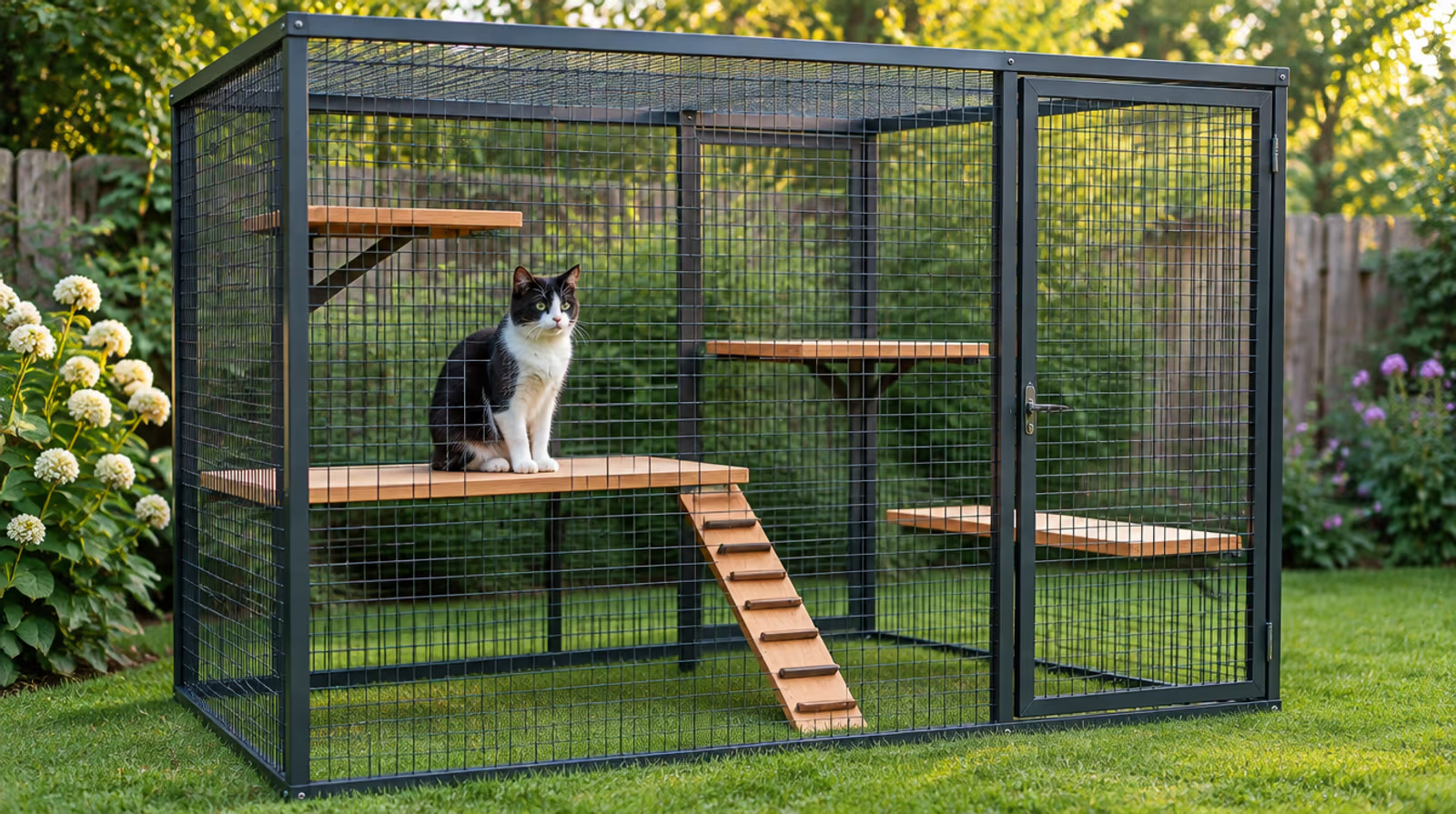
A cat cage or freestanding enclosure is a rigid, self-supporting unit that stands on a patio, terrace or lawn without being attached to the house. It sits between a tent and a custom catio: sturdier than a tent, simpler to place than a built structure. Think of the dark-framed welded-mesh pens with a wooden ramp and shelves that appear in many gardens.
Prices run roughly 100–800€ for a basic powder-coated panel cage and more for large modular systems with shelves and roof. Mesh openings of about 2.5–5 cm are standard; check wire thickness of at least 1.6–2 mm and a full roof panel. Because the unit is freestanding, it is only as secure as its base: peg or weigh down the feet, and don’t put it where the cat can jump onto a fence or shed roof from the top.
Cages are a good middle route for people who want to bring a cat into the garden without building anything and who might move house in a few years, since most can be taken apart and carried.
How to Choose: Space, Budget, Permanence and Supervision
Start with the space you actually have, because it narrows the field fastest. A window and nothing else points to a window enclosure. A balcony points to a balcony enclosure, in netting or steel. A lawn or patio opens up catios, runs, cages and tents. Rented property pushes you toward non-drilling or portable options.
Then decide how permanent it needs to be. If you may move within two years, favour a removable or portable system; a steel window box that clamps on can travel with you, while a built garden catio usually stays. If you own the property and want something to last a decade, a permanent steel or timber structure is the better value over time, even at a higher upfront cost.
Finally, be honest about supervision. Anything fabric-based, a tunnel kit, a tent or a lightweight cage, should be treated as a supervised space. Rigid welded steel with a roof, a secure latch and a closed base can be left alone for a few hours. Any enclosure used unsupervised needs a way back indoors; never shut a cat out in a run with no access to the house.
A fair summary for most households: window or balcony enclosure for flats, garden catio with a connecting tunnel for houses, tent or cage as an affordable first step or a travel option. If your budget is small, a well-built DIY mesh enclosure often beats a cheap kit, as long as you use galvanised or coated welded mesh and not thin chicken wire.
What Every Good Enclosure Has in Common
Whatever the type, the same few features separate an enclosure a cat uses from one it ignores or escapes from. Mesh openings should be about 2.5–5 cm, and 2.5 cm if you have a kitten or want to keep small predators out. The structure should be enclosed on every side a cat can reach, including the top. Edges should be smooth, with no sharp wire ends. Shade and a dry corner are essential, and fresh water should always be available.
Add something to do: a shelf at head height, a scratching post, cat grass in a pot, a log or stable perch. Cats value vertical space and a place to watch from over sheer floor area, so a 2 m² enclosure with two shelves usually beats a bare 4 m² one. Finally, connect it to the house wherever possible, because a cat that can choose to go out and come back uses an enclosure far more than one that is put there.
FAQ
What is the best outdoor cat enclosure?
There isn’t one best type; it depends on your space. For a flat, a steel window or balcony enclosure; for a house with a garden, a roofed catio linked to a tunnel; for occasional use, a portable catio or tent. Rigid steel mesh lasts longest.
How big should an outdoor cat enclosure be?
Roughly 2–3 m² per cat for a walk-in pen, at least 1.8 m high so you can stand inside. Tunnels need a cross-section of about 40–60 cm. Windows boxes are smaller, around 0.3–1 m², and work as lookouts.
How much does an outdoor cat enclosure cost?
Roughly 30–200€ for a tent or tunnel kit, 100–900€ for a window box, 300–3,000€ for a balcony enclosure and 400–6,000€ for a garden catio. DIY is cheaper in materials; custom steel is the most durable.
Can I leave my cat in an outdoor enclosure alone?
Only in a sturdy, roofed, welded-mesh enclosure with a secure latch and a closed base, with shade, water and access back indoors. Fabric tents, light tunnels and portable pens should be supervised.
Do outdoor cat enclosures need planning permission?
Often not for small or temporary structures, but rules vary by country and building. Structures taller than roughly 2 m, near a boundary or on listed or shared buildings may need approval. Rented homes also need the owner’s consent.
What mesh size is safe for a cat enclosure?
Openings of about 2.5–5 cm are standard. Use 2.5 cm for kittens and where you want to keep small predators out. Choose welded galvanised or powder-coated steel of about 1.6–2 mm wire rather than thin hexagonal chicken wire.
Not sure which enclosure fits your window or balcony? Send us a photo and your measurements on WhatsApp and we’ll tell you whether the Cat Balcony window enclosure works, made to measure from 899€, no drilling, free EU delivery.
get BalconyCat →