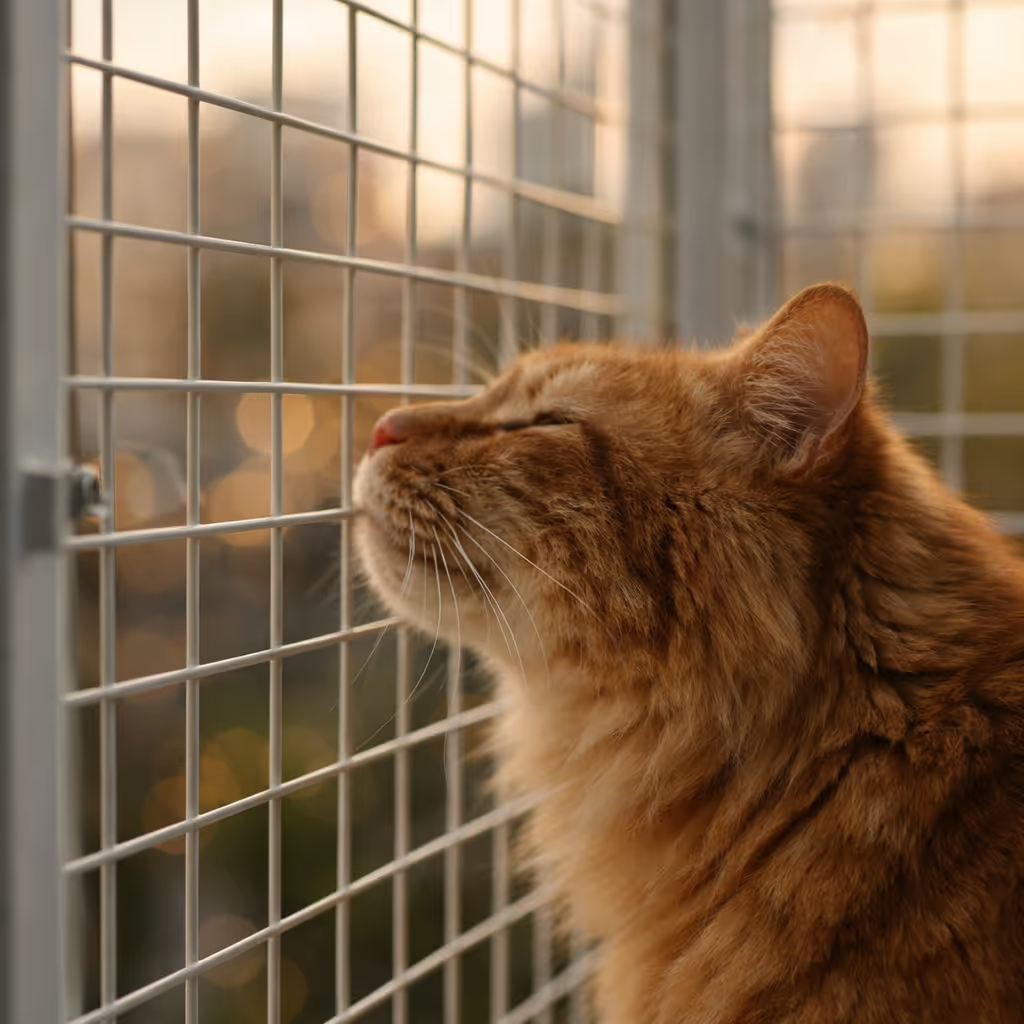
Most cat owners secure the balcony and forget the windows. Yet windows are open far more often: in the bedroom overnight, in the kitchen while cooking, in the bathroom to let steam out. This guide explains why windows are riskier than they look, why tilted windows can trap and injure cats, how each window type behaves, and which kinds of protection actually hold. It ends with a room-by-room checklist you can use today.
Why Windows Are Riskier Than Most People Think
When people think about cat safety at home, they think about the balcony. It is the obvious drop, the place where you can see the danger. Windows feel different. They are part of the room, you open them every day, and your cat has sat on the sill a hundred times without incident. That familiarity is exactly the problem.
A cat does not see an open window as an edge. It sees a view, a breeze, a bird on the gutter, a moth against the glass at night. Cats spend much of their day watching windows, and a window that is open even a little is an invitation to lean further, push harder, or jump. The cat that has never shown any interest in going out is often the one that surprises you on a warm evening.
There are three common ways a window goes wrong. The first is the fall: the window is open, the cat is on the sill, something outside catches its attention, and it jumps or slips. The second is the screen: an ordinary insect screen is in place, the owner assumes it is a barrier, and the cat leans on it, claws it or simply pushes it out of the frame. The third is specific to one type of window, and it is serious enough to deserve its own section.
If you already know the window you need to secure, our welded steel protective mesh is cut to the exact opening and grips the frame without drilling.
The Tilt-Window Danger
Across much of Europe, and especially in German-speaking countries, many windows have a tilt function. Turn the handle one way and the window opens inwards like a door. Turn it the other way and the top of the window tips inwards a few centimetres while the bottom stays hinged. In German this is called a Kippfenster, and it is the standard way people ventilate a room without opening the window fully.
For people, a tilted window is convenient and feels secure. For cats, it can be a trap. The opening forms a V-shape: wide at the top, narrowing to nothing at the sides and towards the hinge. A cat sees the gap at the top, jumps up, and tries to squeeze through. As it slides down into the narrow part of the V, its body gets wedged. The more it struggles, the deeper it slips and the tighter the gap becomes.
Vets in countries where these windows are common know this pattern well, and animal welfare organisations there warn about it every spring and summer. A cat trapped in a tilted window can suffer serious injuries to its spine, hind legs, internal organs and circulation, and a cat left trapped for a long time while the owner is out is in real danger. It is not a rare freak accident. It is a predictable result of a gap shaped exactly like a trap.
The key point: a tilted window is not a safe way to give your cat fresh air, even if the gap looks too small. If you have tilt windows, either keep them closed when your cat is unsupervised in that room or fit a guard that blocks the whole V-shaped opening, including the sides.
Know Your Window Type
Before choosing any protection, look at how each window in your home actually opens. The right solution depends on it.
Casement Windows
Hinged at the side and opening outwards or inwards like a door. When open fully, they leave a large, clear opening, which is the biggest fall risk. They are also the easiest type to secure well, because the frame gives you a clean rectangle to cover.
Tilt-and-Turn Windows
Common across continental Europe. They open fully like a casement or tilt inwards from the top. You need to secure both modes: the full opening and the V-shaped gaps at the sides of the tilt position.
Sliding Windows
Panels that slide horizontally past each other. The gap is a vertical strip that can be as wide as you open it. Cats are good at nudging sliding panels further open with a paw or head, so a partly open slider is rarely as narrow as you think.
Sash Windows
Panels that slide vertically, common in older British and Irish homes. The top sash is often opened for ventilation, which leaves a horizontal gap at the top of the window. A cat that can reach the top of the frame can use it.
Your Options, From Weakest to Strongest
Window Restrictors
A restrictor limits how far a window can open, usually to around 10 cm. It is cheap, simple and useful, and on some windows it is enough for ventilation. But a restrictor only controls the size of the gap. A small cat or kitten can get through surprisingly narrow openings, and a restrictor does nothing about the V-shape of a tilted window. Treat it as a helpful extra, not full protection.
Tilt-Window Guards
These are side panels, usually plastic or metal, that fill the triangular gaps on each side of a tilted window. A good one blocks the whole V so the cat cannot enter the narrowing part at all. They are worth fitting on any tilt window you want to use for ventilation. Check that the guards cover the full height of the gap and that there is no space left at the top for the cat to climb into.
Insect Screens
A standard insect screen keeps flies out. It is not designed to keep a cat in. The fabric is thin, the frame is usually held in by light clips, tension or magnets, and a cat that leans against it or climbs it can tear the mesh or push the whole screen out. Many owners only find this out after the fact. If your only protection is an insect screen, your window is not cat-proof.
Fabric and Nylon Window Nets
Cat nets for windows are stronger than insect screens and much cheaper than steel. They can work, especially on lower floors, but they have the same weaknesses as balcony nets: they sag, they can be chewed or clawed, sunlight weakens the material over time, and they are only as strong as the hooks, adhesive pads or cable ties holding them. On a window, the fixing points are often small and close to the edge, which is where nets tend to fail. If you use a net, check it often and replace it at the first sign of wear.
Welded Steel Mesh Cut to the Opening
This is the permanent answer. A panel of welded steel mesh made to the exact size of the window opening leaves no edges for a cat to push under and no fabric for claws to open up. It does not sag, it does not degrade in the sun, and a cat cannot chew through it. You keep the window open, you keep the air and the view, and the opening is simply closed to the cat.
Our Protective Mesh is built exactly this way. It is welded galvanised steel with a powder-coated finish in any RAL colour, so it can match your window frame. The standard grid is 5×5 cm; for kittens and very small cats we use a 2.5×2.5 cm grid. Each panel is cut to your opening, whether that is a single window, a French balcony door or a full railing run. Steel clips and brackets grip the frame, so there is no drilling, it is safe for rented flats, and it comes off cleanly when you move. It ships flat-packed with a video installation guide, delivery is free within the EU, and we ship worldwide on quote. It is handmade in Poland and starts from 279€.
If you have tilt-and-turn windows or an unusual frame, send us a photo on WhatsApp before ordering. We will look at your frame and confirm what fits.
A Window Enclosure
If you want to give your cat more than safety, a window enclosure goes one step further. Instead of closing the opening, it adds a small steel space outside the window where the cat can sit in the open air. Our Cat Balcony is designed for casement windows, starts from 899€, and is tested to 40 kg static and more than 70 kg dynamic load. It suits homes without a balcony, or cats that need an outdoor spot of their own.
Room-by-Room Checklist
Walk through your home with this list. Check every window, not only the ones you open often. Cats find the one you forgot.
LIVING ROOM: This is usually where the biggest windows are and where they are opened most. Secure every opening window, not just the one next to the sofa. If you ventilate by tilting, fit tilt guards or mesh on every tilt window in the room.
BEDROOM: Windows are often left open or tilted overnight, while you are asleep and not watching. Night is when cats are most active and when insects gather at the glass. This room needs full protection, not a restrictor alone.
KITCHEN: Heat and cooking smells mean the window is open often, sometimes above a worktop the cat can easily jump onto. A counter next to a window is a launch pad. Secure the window or keep the cat out of the kitchen when it is open.
BATHROOM: Small windows are easy to overlook, and bathroom windows are often tilted to let steam out. A small tilted window is still a V-shaped trap. Keep it closed when the cat can get in, or fit a guard.
HOME OFFICE AND SPARE ROOM: Rooms that are used less often are where windows get left open by accident, sometimes for days. Check them before letting the cat in, or secure them once and stop worrying.
FRENCH BALCONY DOORS: A French balcony (a full-height door with a low railing just outside) is a window in all but name. The railing is usually far too open to stop a cat. It needs mesh covering the full opening or the full railing.
Windows are where most people's cat-proofing stops too early. The balcony gets the attention, and the bedroom window gets tilted every night. Go through the house once, secure every opening that matters, and you can leave the windows open without thinking twice.
Send us a photo of your window on WhatsApp. We’ll confirm what fits, cut the steel mesh to your exact opening and ship it flat-packed. From 279€. No drilling. Free delivery across the EU.
get BalconyCat →