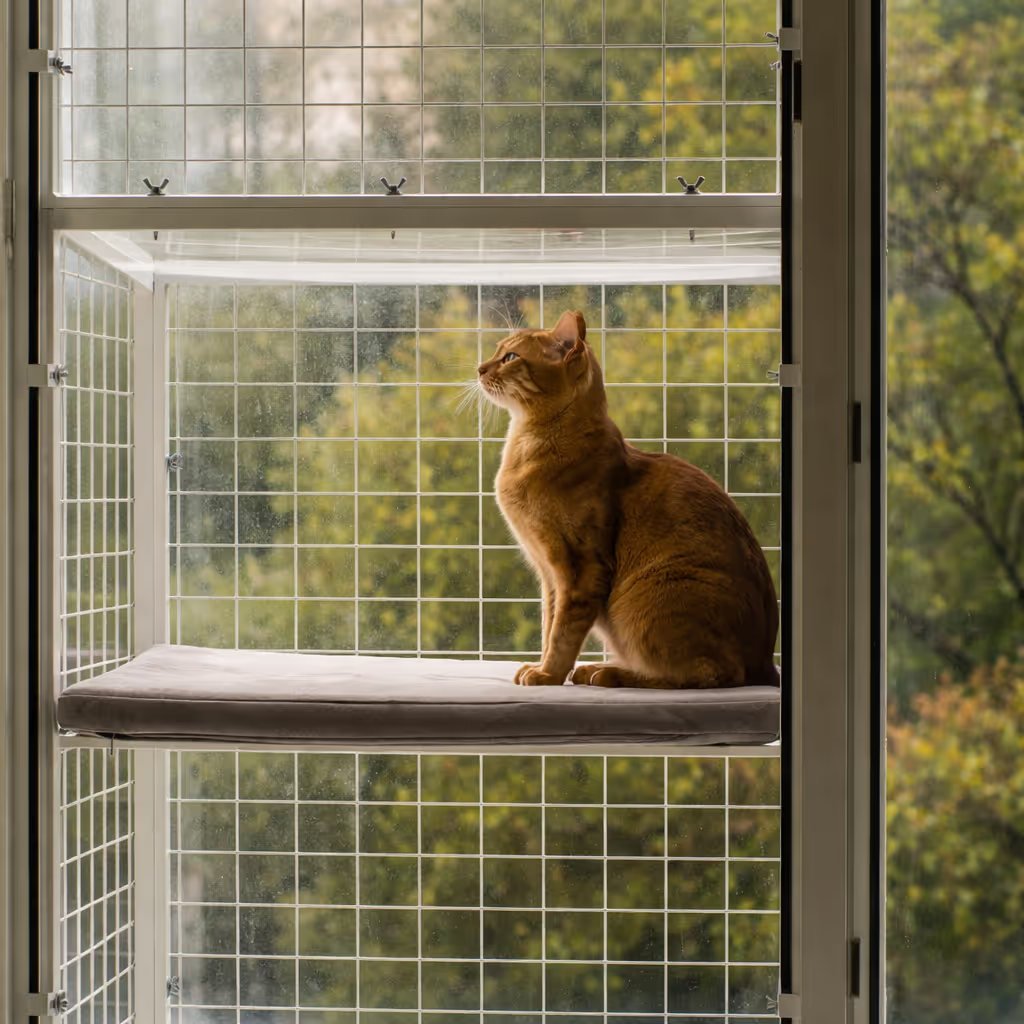
In most of continental Europe, windows open into the room, and many of them also tilt at the top. If that describes your home, you have probably wondered whether a cat window box can work with your window at all. It can, and inward-opening windows are actually one of the easiest types to fit. This guide explains the different window types, why inward-opening windows suit an external enclosure, why the tilt position needs care, and how measuring and fitting work.
Why This Question Comes Up So Often
If you live in Germany, Poland, Czechia, Austria, the Netherlands or Scandinavia, your windows almost certainly open into the room. You turn the handle, pull the sash towards you, and the whole window swings inwards on its hinges. Turn the handle another way and the top of the window tilts in, leaving a narrow opening for air. In German this is called a Dreh-Kipp window. In English it is usually called a tilt-and-turn window.
Most cat window boxes and catios you see online were designed with British or American homes in mind, where windows open outwards, slide sideways or move up and down in a frame. So when you look at photos of a cat sitting in a mesh box outside a window, a fair question follows: will this even work with my window, or will the sash hit the box every time I open it?
The short answer is yes. An inward-opening window is not a problem for an external cat enclosure. In many ways it is the easiest window type to work with. The rest of this guide explains why, how the different window types compare, what to watch out for with the tilt position, and how measuring and fitting work in practice.
If you already know your windows open inwards, the BalconyCat Cat Balcony is made for exactly this: custom-measured to your frame and fitted without drilling.
The Main Window Types, Explained Simply
Here are the common window types you will find in European and British homes.
Inward-opening turn window
The sash is hinged on one side and swings into the room, like a door. When it is fully open, the whole opening is clear. This is the standard window in most continental European flats.
Tilt window
The sash is hinged at the bottom and the top tips inwards by a few centimetres. It lets air in while the window stays mostly closed. Some bathroom and cellar windows only tilt and never turn.
Tilt-and-turn window
A combination of both. One handle position turns the window open like a door, another tilts it at the top. This is the most common window in Germany, Poland, Austria and many neighbouring countries, and increasingly in new buildings elsewhere.
Outward-opening casement
The sash is hinged on the side or top and swings out, away from the room. This is typical in the UK, Ireland and parts of Scandinavia.
Sliding window
One pane slides sideways behind another along a track. Common in some newer flats and in many balcony doors.
Sash window
Two panes slide up and down in a vertical frame. Classic in older British houses.
A window enclosure is designed around casement windows, meaning windows with a sash on hinges. That includes both inward-opening and tilt-and-turn windows. Sliding and sash windows work in a completely different way, and outward-opening casements need a closer look because the sash swings into the space outside. If you have one of these, the simplest step is to send us a photo so we can tell you honestly whether it will work.
Why Inward-Opening Windows Suit an External Enclosure
People often assume an inward-opening window is the difficult case. In fact it is the opposite, and the reason is simple geometry.
The enclosure sits on the outside of the window frame. When your window opens into the room, the sash moves away from the enclosure, not towards it. The sash and the enclosure never compete for the same space. You can open the window fully, and your cat walks straight from the sill into the enclosure through a completely clear opening.
Just as important, you can still close the window whenever you want. The enclosure is outside, the sash is inside, and the window shuts exactly as it did before. When it rains, when you go out, or when the heating is on in winter, you close the window as usual and the enclosure simply waits outside.
Because the Cat Balcony extends beyond the window, your cat is not just sitting on the sill with a screen in front of its face. It can step out and sit outside the building line, with fresh air, sounds and a view on three sides, inside welded galvanised steel mesh.
The Tilt Position: Useful for Air, Dangerous for Cats
The tilt position is great for ventilation. For cats, it is one of the most dangerous window settings in the home. When the top of the window tips in, it creates a V-shaped gap that narrows towards the bottom. A cat trying to squeeze through can slide down into the narrow part and get stuck, often at the belly or hips. In German-speaking countries this is widely known as the Kippfenster danger.
The simple rule is this: never leave a cat alone with a tilted window that has no protection. A bird or an insect outside is enough for even a calm cat to try.
How an enclosure changes the picture
A cat enclosure does not make a tilted window safe on its own. What it does is remove the reason to tilt the window at all. Once the enclosure is fitted, you can open the window fully in the turn position, and your cat gets a wide, clear opening to walk through, with the enclosure outside catching everything beyond it. You get more air than a tilted window gives you, and there is no narrow gap to get wedged in.
So the habit to build is: when the cat is using the enclosure, open the window fully. When you only want a little air and the cat is not supervised, keep that window closed or use a window the cat cannot reach. That way the tilt position stops being part of your cat's daily life.
How Measuring Works
Every Cat Balcony is custom-measured to your window frame, so the fit depends on a few accurate numbers.
You get a short video guide that shows exactly where to put the tape measure and which measurements we need. Most people finish in about three minutes with an ordinary tape measure.
Once you have your measurements, send them to us on WhatsApp together with a couple of photos of the window, from inside and, if you can safely do it, from outside. We check everything for free before anything is made. If a number looks wrong or something about the frame is unusual, we will tell you before production, not after delivery.
The price starts from 899€, and the final price depends on the size of your window. You will know the exact figure before you order.
Installation Without Drilling
The Cat Balcony is fixed with steel corner brackets that grip around the window frame. There is no drilling into the frame, the wall or the façade. The brackets hold the enclosure firmly in place, and when it comes off, there are no holes and no marks left behind.
The enclosure is made of welded galvanised steel with a powder-coated finish, available in any RAL colour, so you can match it to your window frame or façade. It has been tested to 40 kg static load and more than 70 kg dynamic load, and it weighs around 15 kg. The standard mesh is 5×5 cm, with a 2.5×2.5 cm option for kittens. If insects are a concern, there is a mosquito-net add-on.
It ships flat-packed with a video installation guide, so you can follow each step on your phone while you assemble it. Delivery is free within the EU, and worldwide shipping is available on quote. Each enclosure is handmade in Poland.
If You Rent Your Flat
Tilt-and-turn windows are especially common in rented flats across continental Europe, and many rental contracts do not allow drilling into window frames or façades. This is exactly why the no-drill fixing matters.
Because the corner brackets grip around the frame instead of screwing into it, the enclosure leaves no marks and is fully removable. When you move out, you take it off and the window looks exactly as it did before.
What If Your Window Is Unusual?
Not every window fits neatly into a category. You might have a very narrow window, a window with a fixed pane beside the opening one, an old wooden frame, a roller shutter box above it, or a window that only tilts and never turns.
In all of these cases, the answer is the same: take a photo and send it to us on WhatsApp. It costs you nothing, and we would much rather tell you honestly that something will not work than make an enclosure that does not fit. For most inward-opening and tilt-and-turn windows, the answer will be a simple yes.
Questions people ask
Does a cat window box work with inward-opening windows?
Yes. The BalconyCat Cat Balcony fits inward-opening and tilt-and-turn windows. Because the sash opens into the room, it never collides with the enclosure outside.
Can I still close the window when the enclosure is fitted?
Yes. The enclosure sits outside the frame and the sash opens inwards, so the window closes normally whenever you need it to.
Is it safe to let my cat use a tilted window with the enclosure?
The safest habit is to open the window fully when your cat uses the enclosure. A tilted window creates a V-shaped gap where a cat can get stuck, so avoid leaving a cat alone with a tilted window.
Do I need to drill into my window frame?
No. Steel corner brackets grip around the window frame. There is no drilling, no marks, and the enclosure is fully removable, which makes it suitable for rented flats.
How do I know if my window will fit?
Watch the short video guide, take your measurements in about three minutes and send them with a few photos on WhatsApp. We check your window for free before anything is made.
Send us your measurements and a photo of your window on WhatsApp. We’ll check it for free, make the Cat Balcony to your frame and ship it flat-packed. From 899€. No drilling. Free delivery across the EU.
get BalconyCat →