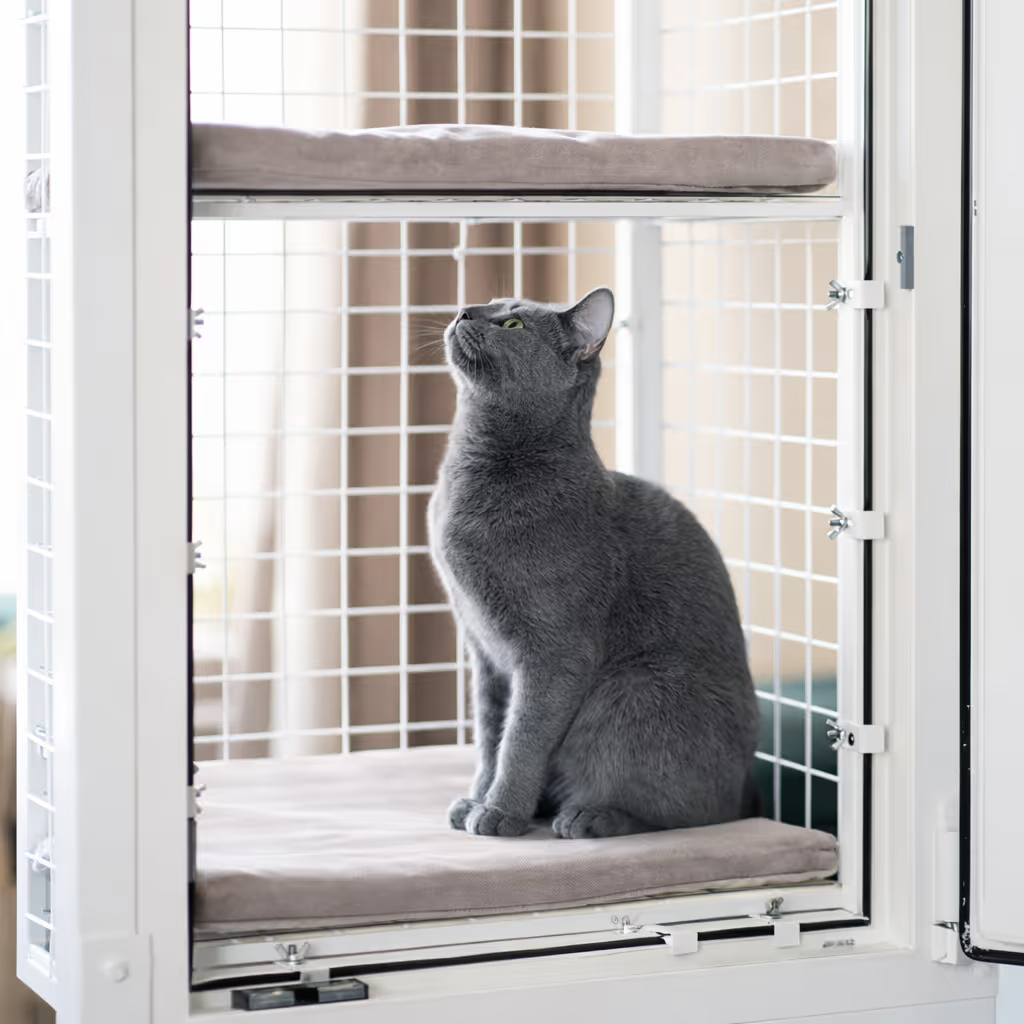
A cat window cage — also called a window catio, window cat enclosure, or cat window balcony — is one of the most practical solutions available for apartment cat owners, and one of the least understood. Most cat owners start by searching for balcony solutions. But the window enclosure category solves a broader problem: it gives your cat safe outdoor access regardless of whether you have a balcony, and without requiring any modification to the balcony structure at all.
What Is a Cat Window Cage?
A cat window cage is a steel or mesh enclosure that mounts to the outside of a window frame and extends outward from the building, creating a secure outdoor space that your cat can access by going through the open window. The enclosure is enclosed on all sides: front, sides, top, and bottom.
Your cat enters through the window opening, sits inside the enclosure, and has access to fresh air, outdoor sights and sounds, and the sensory experience of being outside — all within a structure they cannot escape from and that nothing can enter. The window itself can still be opened and closed normally when the enclosure is not in use.
It is not a bird feeder. It is not a planter box. It is a structurally sound, load-tested outdoor space for a cat, accessed through a window rather than a door.
How Does It Attach?
The attachment method is one of the most important features of any window enclosure — both for safety and for practical reasons around tenancy and drilling. There are two main attachment approaches.
BRACKET-BASED (NO DRILLING): The enclosure frame has steel corner brackets that grip around the window frame — top, bottom, and sides — using tension and mechanical contact rather than screws or anchors. No holes are made in the wall or window frame. No marks are left when the enclosure is removed. This is the correct approach for renters, for properties where drilling is not permitted, and for anyone who wants the installation to be fully reversible.
The BalconyCat window enclosure uses a bracket-based attachment system. The corner brackets are made from the same galvanised steel as the frame, and the bracket system is tested at 70+ kg of dynamic load — more than enough to handle any force a cat can generate.
SCREW-FIXED: Some window enclosures are designed to be screwed directly to the window frame or into the wall. This is more permanent, but is not appropriate for rental properties and is generally not necessary given that bracket-based systems achieve the same structural result. If a product description does not specify how it attaches, ask before purchasing. The attachment method determines whether you can install it legally and whether you will get your deposit back.
What Window Types Does It Work With?
Most window cat enclosures are designed for casement windows — windows that open outward on hinges. The enclosure mounts to the window frame, and the window opens inward to give the cat access to the enclosure.
If you've decided a solid enclosure is what you need, the BalconyCat window enclosure is custom-made to your window and tested to 40 kg.
OUTWARD-OPENING CASEMENT WINDOWS: Fully compatible. The window opens outward, but the enclosure is positioned so that opening the window creates the access point without the window interfering with the enclosure frame. INWARD-OPENING CASEMENT WINDOWS: Also compatible, and often the simpler installation. The window opens into the room, the enclosure sits outside, and the cat passes through the open window into the enclosure.
TILT-AND-TURN WINDOWS: Compatible in many configurations. The “turn” position (fully open) creates a large opening that serves as the access point. SASH WINDOWS (SLIDING VERTICALLY): Compatible in most cases, with the bottom sash raised to create the access opening. FIXED / NON-OPENING WINDOWS: Not compatible in the standard configuration. SMALL WINDOWS (UNDER ~40CM WIDTH): May not be practical depending on cat size — a window under 40cm wide does not provide a comfortable access opening for a large breed cat.
If you have an unusual window type — a pivot window, an angled skylight rooflight, or a non-standard opening configuration — contact the supplier before ordering to confirm compatibility. Most suppliers can advise based on measurements and photos.
What Size Options Are Available?
Window enclosures are almost always custom-made to the customer’s specific window measurements. This is the key difference from off-the-shelf cage products — the enclosure is built to fit your window exactly, not adapted from a standard size.
WIDTH: Matches the window width, typically 60cm to 180cm. DEPTH (how far it extends from the wall): Usually between 40cm and 70cm. Deeper enclosures give more space for the cat to move and turn around; shallower ones are less visible from outside and more practical for narrow building ledges. HEIGHT: Can match the full window height or be a lower panel that sits at the bottom of the window.
When ordering a custom enclosure, you will typically need to provide: the internal window frame width, the distance from the window frame to the external facade (to confirm depth clearance), and the window opening height. A good supplier will guide you through the measurement process and confirm the design before production.
How Is It Installed?
For a bracket-based no-drill system, installation typically involves: fitting the corner brackets to the window frame at the marked positions; positioning the enclosure frame against the window exterior and engaging the brackets; tightening the bracket connections; fitting the mesh panels if supplied separately; and testing the completed structure with physical force on each panel and the frame.
Installation for a standard window typically takes one to two hours with two people. The second person is needed to hold the enclosure in position while brackets are tightened — it is not a single-person job. A video installation guide is standard for quality suppliers. Direct support during installation — via phone or WhatsApp — should also be available.
How Is It Different from a Balcony Catio?
SPACE REQUIREMENT: A window enclosure requires no balcony or outdoor floor space. It hangs from the window and is self-supporting. A balcony catio requires balcony floor area.
INSTALLATION DEPENDENCY: A window enclosure is independent of the balcony structure. It works whether or not you have a balcony, what type of railing you have, or whether your balcony roof provides an overhead anchor point. ACCESS POINT: Your cat accesses a window enclosure through the window, which you control. Access to a balcony catio is through the balcony door, which is harder to manage in households with multiple people or children.
SIZE: A window enclosure is smaller than a full balcony catio. It gives a cat an outdoor perching and sitting space rather than room to run. For most indoor cats whose goal is fresh air and outdoor sensory experience rather than exercise space, this is more than adequate. COST: A quality custom-made window enclosure starts at around 899€. A properly built, full balcony catio with custom dimensions and steel construction will cost more.
Is It Right for Your Flat?
A cat window cage is likely the right solution if: you do not have a balcony, or your balcony cannot be safely enclosed without significant structural work; you rent your property and cannot drill; you have a Juliet balcony or French door with no usable platform; your balcony is small and cannot accommodate a freestanding enclosure with meaningful space; or you want a clean, custom-fit installation that is tested and known to hold.
It may not be the only or best solution if: you have a large balcony with full overhead cover and want to give your cat significant floor space to roam; or you have multiple cats and need a much larger enclosure.
If you are not sure which category you fall into, or if you have an unusual window type or building configuration — send us your window dimensions and a photo. We will tell you honestly whether a BalconyCat enclosure fits your home.
get BalconyCat →