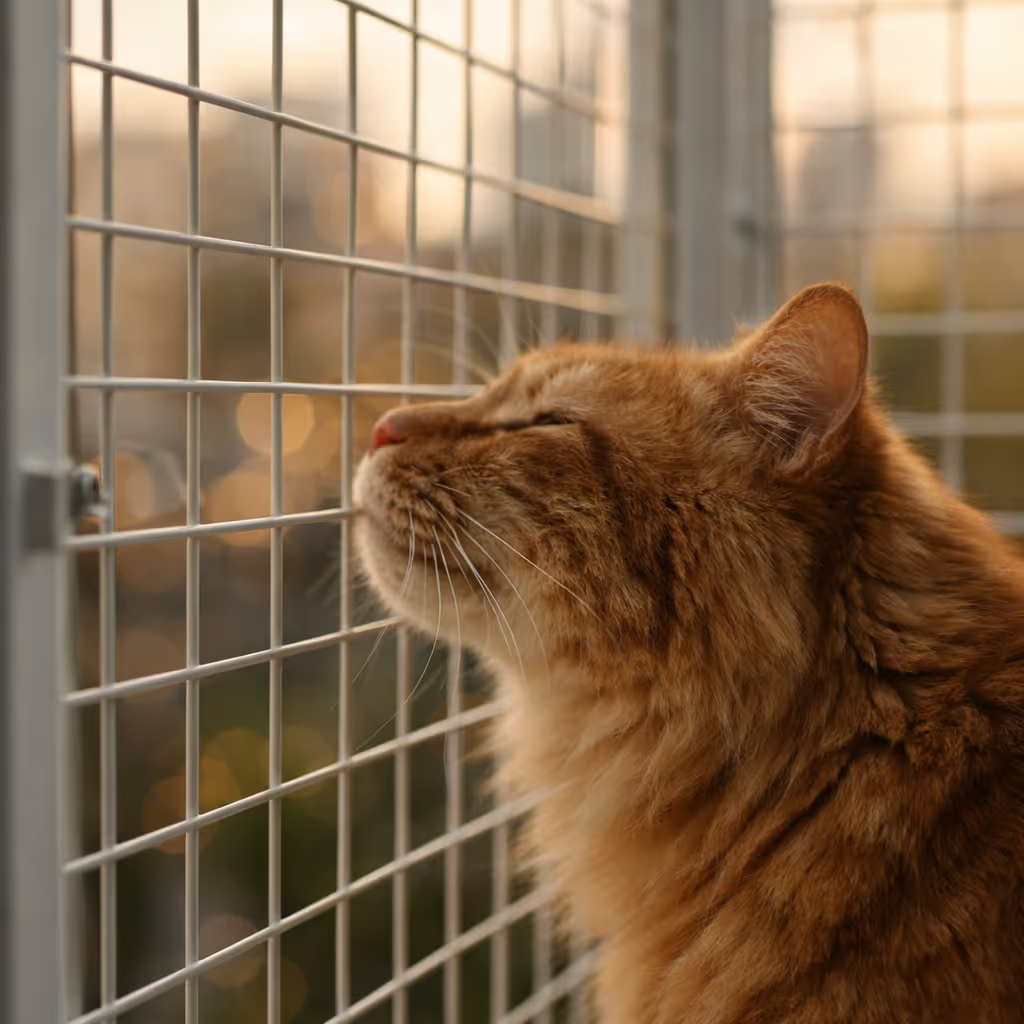
"Cat cage for balcony" is one of the most common searches cat owners type when they start thinking about outdoor safety — and it is one of the least useful phrases to search, because it describes an outcome rather than a product category, and the results it returns range from genuinely safe to completely inadequate.
Why “Cat Cage” Is a Confusing Search Term
The word “cage” carries a specific meaning in most contexts: a rigid, fully enclosed structure that an animal cannot leave. In the balcony cat context, people use it loosely to mean any kind of enclosure, barrier, or containment solution for a cat on a balcony.
What comes up in search results under this term includes: soft mesh pop-up tents designed for garden use, modular metal panel systems designed for garden runs, net systems that attach to balcony railings, full steel catios, window-mounted enclosures, and freestanding outdoor pens with no fixed attachment.
These products are not equivalent. They vary enormously in build quality, load capacity, attachment method, and — most importantly — how long they remain safe under real-world conditions with a real cat using them daily. The term “cage” does not tell you anything about which of these categories a product belongs to. You need to know what to look for.
Category 1: Soft Mesh Enclosures (Pop-Up Tents and Tunnels)
These are the most widely available and cheapest products that appear under “cat cage for balcony” searches. They look like pop-up camping tents or tube tunnels made from a soft, flexible mesh material. Price: typically 30€–80€.
What they do: provide a temporary enclosed space. The cat is inside the mesh, which keeps them contained in normal conditions. What they don’t do: hold against a determined cat. Soft mesh enclosures are not load-rated. The mesh is not welded — it is woven or sewn — and it deforms under sustained pressure. A cat that presses repeatedly against one point, or that scratches and pulls at a seam, will eventually create a gap large enough to exit through.
They also deteriorate rapidly in outdoor conditions. UV exposure breaks down the mesh fibres, stitching loosens in damp, and zip fastenings corrode. A pop-up mesh enclosure that is left outdoors year-round is not a six-month product. It is often a two-to-three month product.
The correct use case: supervised, temporary outdoor access in a garden for a calm adult cat. Not a substitute for a proper balcony enclosure.
Category 2: Modular Panel Systems
A step up in quality: modular systems using rigid panels — typically a metal or coated wire grid — that click or attach together to form an enclosure. Products like the Omlet Outdoor Cat Run fall into this category. Price: 150€–600€ depending on size and configuration.
What they do: provide a more structurally robust enclosure than soft mesh. The panels are rigid, the frame is aluminium or steel, and the mesh is typically welded rather than woven. What they don’t do: custom-fit your balcony. Modular systems are designed for a generic user profile, which means the dimensions are fixed and you adapt them to your space rather than the other way around.
If you've decided a solid enclosure is what you need, the BalconyCat window enclosure is custom-made to your window and tested to 40 kg.
Gaps at the edges — between the enclosure and the wall, railing, or floor — need to be managed separately. If those gaps are not fully addressed, the enclosure has an exit point regardless of how robust the panels are. They also do not attach to the wall or window structure. They sit on the balcony floor, which means they can be tipped or shifted under sufficient load.
The correct use case: a balcony or terrace with enough floor space for the enclosure to sit freestanding, where the perimeter can be fully sealed against the balcony structure.
Category 3: Railing-Attached Net Systems
Net systems that attach to the balcony railing using clips, straps, or tension poles. These cover the balcony perimeter from the railing upward, typically with a fabric or wire mesh. Price: 50€–250€.
What they do: provide a perimeter barrier against a cat walking through railing gaps or climbing over the side. If the net reaches to a ceiling or overhead overhang, they can form a fully enclosed space. What they don’t do: provide reliable attachment over time. Strap and clip systems loosen with temperature cycling and wind load. A net that was taut in summer may have enough slack by spring for a motivated cat to find an exit.
UV-exposed synthetic netting also degrades in the same way as soft mesh enclosures. On a roofless balcony — no ceiling overhead — a side-only net creates a barrier against falling through the sides but does not prevent a cat from climbing up and over the top of the net itself.
The correct use case: a covered balcony with an overhead structure to anchor the net top, as a secondary barrier alongside a more robust primary containment.
Category 4: Fixed Steel Enclosures
The category that most searches for “cat cage for balcony” are actually looking for, whether they know it or not. A fixed steel enclosure is a purpose-built structure made from welded steel with a powder-coated or galvanised finish, attached to the window frame or balcony structure using fixed brackets, and load-tested to handle the real-world forces a cat — or a person testing the enclosure — can exert. Price: 600€–1,200€+ depending on specification.
What they do: provide genuine, tested containment. The mesh is welded at every intersection — not woven, not sewn — so it cannot be pushed open or separated at a junction. The frame does not flex under lateral load. The attachment points are fixed, not strapped, and do not loosen over time.
What they don’t do: cost as little as the alternatives. The price reflects the materials, the manufacturing, and the testing that makes the product actually work for the ten-plus years it is designed to last.
The correct use case: any situation where you need your cat to be genuinely safe on the balcony, unsupervised, over the long term.
What to Look for on Any Balcony Cat Enclosure
MESH TYPE: Is it welded or woven? Welded mesh has fixed intersections and cannot be pushed open. Woven mesh can. If the product description does not specify “welded mesh,” assume it is woven.
MESH SIZE: Is the opening size appropriate for your cat? 5×5 cm for adult cats. 2.5×2.5 cm for kittens or small breeds. Larger openings create entrapment and escape risks.
LOAD RATING: Does the manufacturer state a load capacity? Any credible structural product has one. Absence of a stated load rating means absence of load testing.
ATTACHMENT METHOD: How is it connected to the building? Straps and clips are temporary. Brackets are fixed. Know which one you are buying.
OUTDOOR RATING: What finish protects the metal from corrosion? Powder-coated galvanised steel handles outdoor conditions for decades. Untreated or painted steel does not.
UV RESISTANCE: If any part of the enclosure is plastic, mesh fabric, or zip ties — what is the UV resistance rating? Outdoor sun exposure degrades most plastics and synthetic fabrics within twelve to twenty-four months.
The One Test That Matters After Installation
Whatever you buy, test it before your cat uses it. Not visually. Physically.
Push against every panel. Pull at the frame. Apply your full body weight to the sections your cat will jump against, climb on, or press toward. If anything moves, shifts, rattles, or separates — it needs attention before your cat goes near it.
This test takes five minutes. It is the difference between an enclosure you trust and one you hope works. For a cat on a third-floor balcony, hope is not enough.
If you want to talk through which type of enclosure fits your specific balcony and window setup, we are happy to help.
Get Balcony Cat →