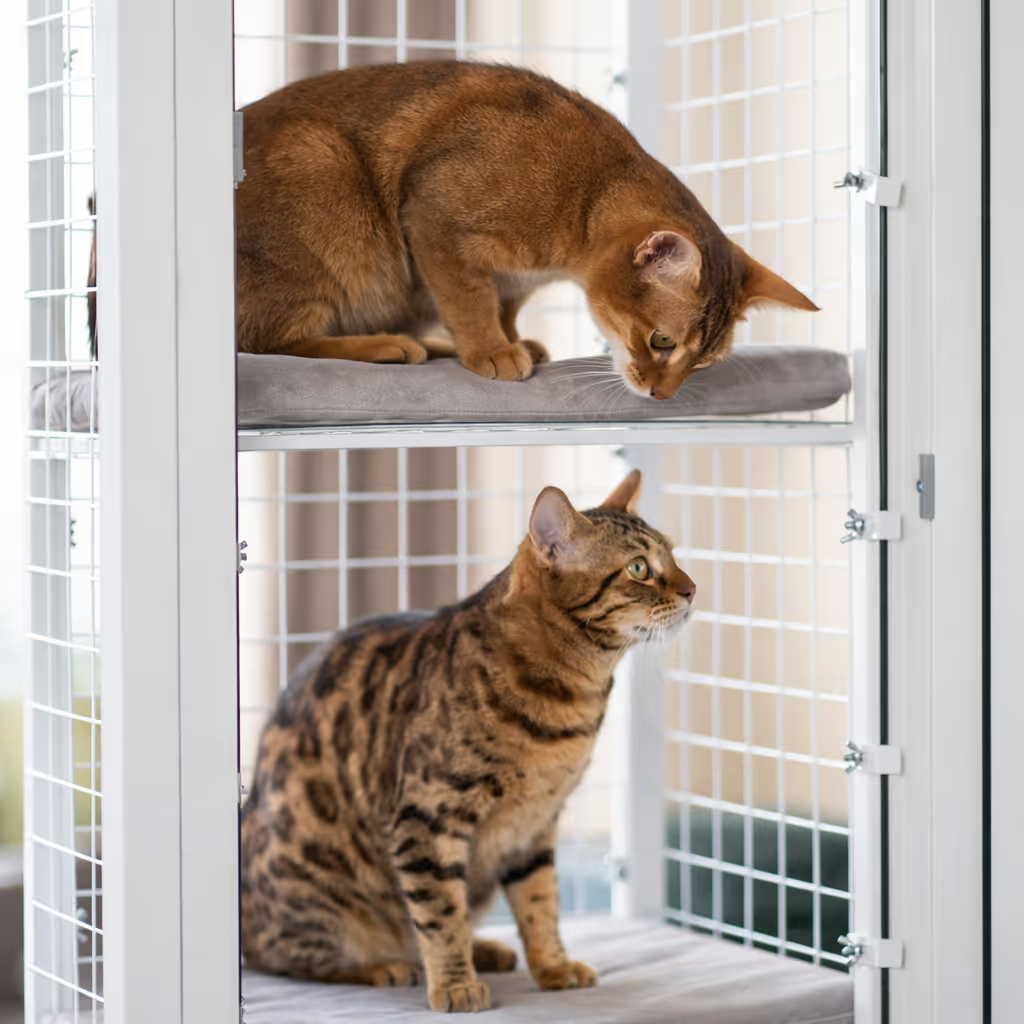
Most cat enclosure guidance is written for a single cat. The calculations change when you have two — not dramatically, but in specific ways that matter and that are easy to overlook when you are buying an enclosure that looks big enough at first glance.
The Space Question
The minimum space requirement for a single cat in an outdoor enclosure is generally considered to be around 0.5 to 1 square metre of floor area — enough to sit, turn around, and change position. For two cats, the arithmetic is not simply doubled. It is higher than doubled, because the social dynamic between two cats in a shared space introduces a territorial dimension that does not exist for a single cat.
Two cats that get along perfectly well inside the flat can behave differently in a small outdoor enclosure. The enclosure is a novel environment with limited exit options. One cat may claim the best viewing position — typically the highest point — and the other may feel excluded or pressured. In a space with only one natural exit, one cat can inadvertently block the other’s access to the inside.
The practical minimum for two cats in an outdoor enclosure is approximately 1.5 to 2 square metres of usable floor area, with at least two elevated surfaces at different heights so both cats can occupy a comfortable position simultaneously without being in direct competition. If your enclosure is a window-mounted cat balcony — typically 0.5 to 1 square metre — it can work for two cats with some caveats, covered below.
Vertical Space Is More Important Than Floor Space
Cats do not share space the way humans do. In a cat household, social harmony is partly maintained by vertical differentiation — higher-ranking or more confident cats occupy higher positions, lower-ranking cats occupy lower positions, and both feel comfortable because the hierarchy is spatially expressed.
A window enclosure or balcony catio with only one level forces both cats into the same horizontal plane with no way to establish comfortable spatial distance. This is manageable for very bonded cats that regularly sit in physical contact, but it creates friction for most pairs. Before adding a second cat to any outdoor enclosure, add a second level: a shelf, a hammock at a different height, or an elevated platform. This single change resolves the majority of two-cat outdoor space conflicts.
The Access Point Problem
A single window or door access point works fine for one cat. For two cats, a single access point creates a potential bottleneck that is worth thinking through. Cats queue at access points. If one cat decides to sit in the window opening — either coming or going — it can block the other cat for extended periods. This is usually annoying rather than dangerous, but in a small enclosure where one cat is becoming anxious and wants to get back inside, a blocked access point creates a stress situation.
Whatever your situation, the safest starting point is a custom steel window enclosure sized to your exact window.
For a window-mounted enclosure, the access point is the window opening. A standard casement window provides a reasonably wide opening that two cats can navigate. Narrower windows — under approximately 40cm — can create more friction, particularly for larger breed cats. If your enclosure has the option of a secondary access point, this is worth considering for a two-cat household.
If a second access point is not possible, monitor the two cats during their first weeks of shared outdoor access and watch for one cat consistently blocking the other. If that pattern emerges, stagger their outdoor access times rather than force shared use of a single access point.
Structural Load: What Two Cats Actually Means
Two cats using the same enclosure simultaneously doubles the static load and can more than double the dynamic load, because the cats may interact — chasing, jumping past each other, startling one another — in ways that a single cat never produces. Check that your enclosure’s load rating accounts for two cats. An enclosure rated for 20kg of static load sounds adequate for two 5kg cats. But the dynamic load of two cats jumping simultaneously can produce peak forces that challenge a 20kg static rating in ways that two cats sitting quietly does not.
For BalconyCat’s enclosure, the 40kg static load rating and 70+ kg dynamic test rating provides genuine margin for a two-cat household including large breeds. Assess your specific enclosure’s rating honestly against this use case. Also: two cats means twice the wear on the mesh. Inspect the mesh more frequently — monthly rather than seasonally — in the first year of two-cat use, to catch any deformation or wear at specific points that the combined use pattern creates.
Introducing Two Cats to the Enclosure
The introduction process for two cats requires one additional step compared to the single-cat guide: introduce them separately first. The first experience of an outdoor enclosure is novel and potentially stressful. Adding the social complexity of another cat’s presence to that first experience creates two unpredictable variables simultaneously. Introducing each cat separately lets each one build familiarity with the space without the added dynamic of the other cat’s behaviour.
WEEK 1: Cat A alone, supervised, following the standard graduated introduction (see our introduction guide). Cat B has no balcony access during this period. WEEK 2: Cat B alone, supervised, following the same process. Cat A continues to use the space as normal but not simultaneously. WEEK 3: First joint sessions, supervised, with you present to observe how they interact in the shared space. Watch for access point blocking, competition for the best elevated position, and any sustained stress signals (flattened ears, tail position, rapid return to the access point) from either cat.
WEEK 4 onwards: extend joint sessions as both cats demonstrate comfort with the shared space. Move toward unsupervised joint access only after several supervised sessions with no friction. This process takes longer than a single-cat introduction. It is worth the time. Two cats that have a bad first shared experience in the enclosure can develop avoidance behaviour that is difficult to reverse.
The Window Enclosure for Two Cats: Does It Work?
A window-mounted cat enclosure is designed primarily as a single-cat outdoor perching and enrichment space. It can work for two cats, particularly two small or closely bonded cats, with the right setup.
ENCLOSURE DIMENSIONS: A wider enclosure (matching a wide window, extending across a double window, or custom-specified wider than standard) gives both cats more room. BalconyCat enclosures are custom-made — a wider-than-standard specification is possible and is the right call for a known two-cat household.
INTERNAL LAYOUT: Add a shelf or hammock inside the enclosure to create a second level. Without it, two cats in a single-level space is too cramped for comfortable shared use. CATS’ RELATIONSHIP: Two cats that regularly sleep in contact indoors will share a window enclosure comfortably. Two cats that maintain clear spatial separation indoors will need more room to be comfortable simultaneously.
If you have two cats and are considering a window enclosure, mention this when you contact us. We will factor it into the dimension recommendation and suggest the right configuration for your specific pair.
get BalconyCat →