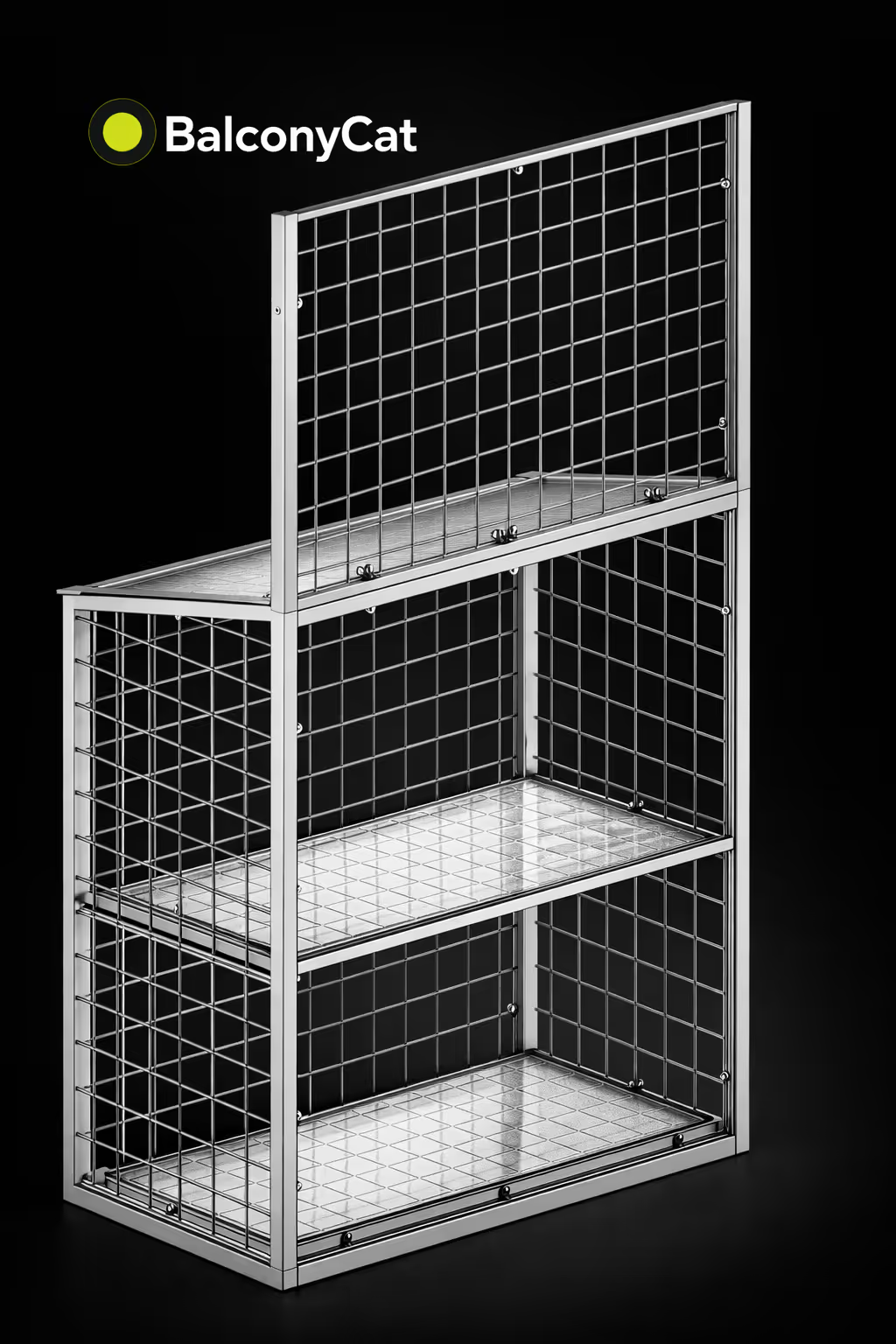
The appeal of a portable catio is obvious — especially for renters. You do not drill anything, you can take it with you when you move, and you can put it away in winter without leaving a mark. The problem is that portability and structural safety are, to a significant degree, in genuine tension. The features that make an enclosure easy to move are the same features that make it less secure over time under real-world cat use.
What “Portable” Actually Means in Practice
The word “portable” covers several distinct product types that behave very differently.
COLLAPSIBLE / POP-UP ENCLOSURES are soft-sided mesh structures that fold flat for storage, similar to a pop-up laundry basket. They set up in seconds, weigh almost nothing, and pack away easily. They are genuinely portable in the full sense of the word.
DISASSEMBLE-AND-REASSEMBLE ENCLOSURES are rigid panel systems that break down into components for transport or storage, but require meaningful reassembly time — often thirty minutes to an hour. They are portable in the sense that you can move them, but “portable” overstates how easy that is in practice.
NO-DRILL FIXED ENCLOSURES are products that attach to a window or balcony structure using brackets or clamps rather than screws, making them removable without leaving permanent marks. These are often described as “portable” in product listings, but they are not designed for regular disassembly — they are designed to be installed once and removed once, typically when you move home. These three categories are very different products. Knowing which one a listing is describing before you buy matters more than the product photos suggest.
Collapsible and Pop-Up Catios: The Honest Assessment
Pop-up mesh enclosures are the most genuinely portable option and the one most commonly found under “portable catio” searches. They range from small igloo-shaped tents to larger tunnel systems that connect multiple pods. They are cheap (30€–100€ typically), available everywhere, and genuinely easy to set up and put away.
The structural reality: soft mesh with no rigid frame is not a containment solution for a motivated cat. The mesh is woven, not welded, which means intersections can separate under pressure. The fabric stretches. The zips are the weakest point — any cat that works at a zip or a seam with sustained attention will eventually create an exit.
The outdoor reality: most pop-up enclosures are made from polyester or nylon mesh that is not rated for prolonged outdoor UV exposure. Left on a balcony in direct sun through a summer, the material becomes brittle and loses tensile strength. What held a 5kg cat in May will not hold the same cat in September. Where they work: short supervised sessions in a garden for a calm, elderly, or non-climbing cat. On a balcony, particularly an elevated one, they provide false security rather than real containment.
Verdict: if your cat is young, athletic, or has any history of escape attempts — do not use a pop-up enclosure unsupervised on a balcony. If your cat is fifteen years old and barely climbs onto the sofa, it is probably sufficient with supervision. Know your cat.
The most reliable way to give your cat that outdoor space is a custom steel window enclosure that fits your window exactly — no drilling, and no gaps to slip through.
Disassemble-and-Reassemble Panel Systems
Modular rigid-panel systems (like Omlet’s Outdoor Cat Run) can technically be disassembled and moved. In that sense they are “portable.” In practice, disassembling, transporting, and reassembling a modular cat run takes most of an afternoon and requires knowing which panels go where. These products are designed to be semi-permanent installations that can be relocated if needed — not something you put up and take down regularly.
Structurally, they are considerably better than pop-up enclosures. The panels are rigid and the mesh is typically welded. The assembly uses mechanical connections rather than fabric. A modular panel system that is properly assembled and sized correctly for your balcony is a genuinely secure enclosure.
The limitations: they are freestanding. They sit on the balcony floor, which means they can tip or shift under sufficient lateral load if they are not braced against a wall. The connection points between panels are the weakest structural element — check them regularly for loosening. They also require balcony floor space. If your balcony is small, a modular system may occupy the entire usable area.
Verdict: a solid option for a balcony with sufficient floor space, where “portable” means “I can take it when I move” rather than “I can put it up and down each day.”
No-Drill Fixed Enclosures: The Right Category for Most Renters
This is the category that resolves the tension between portability and safety most effectively — not by being portable in the collapsible sense, but by being fully removable without drilling. A no-drill fixed enclosure uses brackets, clamps, or compression fittings to attach to the window frame or balcony structure without screws or wall anchors. It is fixed in the sense that it does not move during use and is properly load-rated. It is portable in the sense that it can be fully removed by reversing the installation process, leaves no marks, and can be reinstalled at a new property.
The BalconyCat window enclosure falls into this category. It uses steel corner brackets that grip around the window frame. It does not move in use, handles the load of a large cat jumping against the mesh, and can be fully removed in under an hour when needed.
The trade-off compared to a pop-up enclosure: it is not something you put away on a Tuesday evening and reassemble on Wednesday. It is a one-time installation designed to stay in place for the duration of your tenancy (or longer). “Removable” is accurate. “Portable” in the everyday sense is not.
Verdict: for renters who need genuine safety without drilling, this is the correct category. Do not let the price of a pop-up enclosure make a no-drill steel bracket system look expensive — they are not solving the same problem.
If You Need Something Cheaper Right Now and Are Moving Soon
We understand that 899€ isn't always possible if you're between flats or in a short-term letting situation. For genuinely temporary situations (under 12 months), a good modular panel system in the 150€–250€ range is a reasonable short-term solution. Prioritise: railing-clip attachment (not drilled); metal-framed panels (not plastic — plastic warps and panels lose their shape after the first disassembly); a roof panel (without one, climbing cats will exit the top). Treat it as the temporary measure it is. When you're in a stable flat for longer than a year, the steel enclosure is the right next step.
The Question to Ask Before You Buy
Before purchasing any portable catio for a balcony, ask yourself one specific question: what happens if my cat decides it wants to leave?
Not a calm, settled cat. Your cat, on a day when there is a bird on the railing opposite, or a sound from below that triggers prey instinct, or simple boredom on a warm afternoon. What happens when that cat presses against the mesh, tests the zip, or climbs toward the highest point of the enclosure?
The answer to that question — not the product photos, not the word “portable,” not the price — tells you whether what you are looking at is actually safe for your situation.
If you are not sure what the right solution is for your balcony and your cat, we are happy to help you think it through.
get Balconycat →