You've decided to sort this. Good. This post skips the background reading and gets straight to the action steps — what to assess, what to fix, and exactly what to order depending on your situation.
Step 1: Assess Your Actual Risk Level
Before deciding what to buy, understand what you're dealing with. The right product depends on three variables.
YOUR FLOOR. Ground floor or first: fall injury risk is real but rarely fatal, more options available at lower cost. Second through fifth: medium-height falls cause serious injuries at high rates, structural containment required. Sixth and above: full structural containment required, no net-only solution is appropriate here.
YOUR CAT. Calm, older, non-climbing adult: net or modular panel systems may be sufficient. Young, athletic, high prey drive, or previous escapee: only structural containment (steel enclosure) is appropriate. Kitten under 4 months: needs fine mesh (2.5×2.5 cm) — standard 5×5 cm mesh is not safe.
YOUR TENANCY. Owner-occupied: any installation method available, including drilling. Renting: drilling not permitted in most tenancies — bracket-mounted or tension-based systems only. Score yourself. If you're on the fourth floor with a two-year-old Bengal in a rented flat, you are in the maximum-containment category. If you're on the ground floor with a twelve-year-old indoor cat, you have more flexibility.
Step 2: Identify Your Opening Type
What type of window or door accesses the balcony? CASEMENT WINDOW (swings open on a hinge): most compatible with window enclosures. A custom steel enclosure mounts to the external frame and is the most structurally sound solution available. TILT-AND-TURN WINDOW: more complex, can be adapted but requires specific measurement — contact us before ordering. SASH WINDOW (slides up and down): window enclosures are more difficult on sash frames; balcony-level netting or modular panels are usually more practical. FULL-HEIGHT BALCONY DOOR: gives access to a full platform balcony, full balcony enclosure system is the right category. JULIET BALCONY (floor-to-ceiling doors with shallow external rail, no floor): the most complex case — see our dedicated Juliet balcony guide before ordering anything.
Step 3: Choose Your Product Based on Your Risk Level
Low Risk: Ground/First Floor + Calm Adult Cat + Owner-Occupied
Best product: premium balcony net or modular panel system, 60€–250€. Why: adequate containment for the risk level, lower cost is justified, drilling possible if needed. Where to buy: pet specialist retailers, Amazon, Zooplus. Look for high-denier netting with UV stabilisation. Verify mesh size against your cat's head diameter.
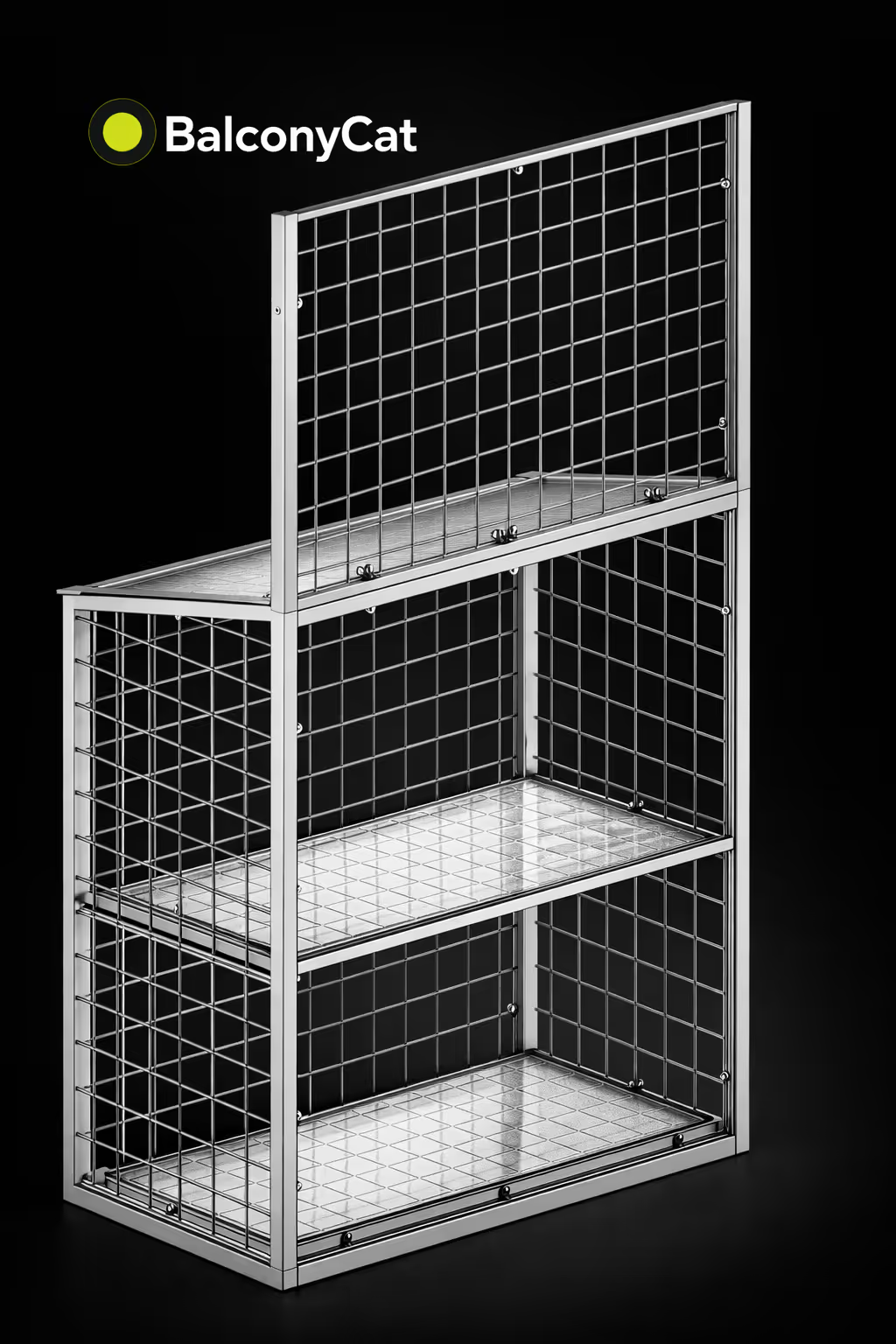
Whatever your situation, the safest starting point is a custom steel window enclosure sized to your exact window.
Medium Risk: Second–Fourth Floor + Adult Cat + Renting
Best product: full modular panel enclosure with roof panel, or custom steel window enclosure. Why: net-only systems at this height carry too much attachment risk, you need something more structural. Where to buy: Omlet for modular (if their sizes fit your configuration); BalconyCat for custom steel window enclosure.
High Risk: Fifth Floor+ / Young or Athletic Cat / Previous Escape History
Best product: custom steel window enclosure (BalconyCat) or full professionally installed balcony enclosure. Why: this risk level requires structural containment with no reliance on adhesive fixings, degradable materials, or connector joints. The consequence of failure does not permit a margin for error. Where to buy: BalconyCat for window enclosure, professional installation services for full balcony enclosure.
Step 4: Take Measurements Before You Order Anything
Whatever product you're buying, measure your window or balcony opening before you order. For a window enclosure: measure the external width of the window frame (between outside edges, not inside edges); measure the external height from the window sill to the top of the frame; note whether the window opens inward or outward; note any obstructions directly below the window. For a balcony enclosure: measure the full width of each open side; measure the full height from balcony floor to ceiling; count the number of open sides requiring enclosure; identify the railing type and whether it has suitable attachment points.
If you're ordering from BalconyCat, we have a 3-minute video guide that walks you through exactly what to measure. You can also send us photos on WhatsApp and we'll check everything before production starts.
Step 5: Order, Install, Test
Once your product arrives, installation is typically 1–3 hours for a window enclosure or 2–6 hours for a full balcony panel system. Two people recommended for both.
After installation: test it properly before your cat uses it. Push hard on every panel. Pull at every corner. Put your full bodyweight on a window enclosure if it's accessible. If anything moves, it needs addressing before the cat goes in. A properly built steel enclosure will not move when you do this. A net or modular system may show minor flex at the attachment points — which is the signal to reinforce before your cat finds the same flex and tests it on their own terms.
If You're Ready to Order a BalconyCat Enclosure
Here's what happens next: 1. Watch the measuring video on our site (3 minutes). 2. Send us your measurements — email or WhatsApp. 3. We confirm everything is correct. 4. We build it by hand in Poland (typically 2–4 weeks). 5. It ships flat-packed to your door. Free across Europe. 6. You install it following the video guide. We're on hand if you need help. 7. Your cat has a safe outdoor space. You stop thinking about this. Starting from 899€. We confirm the exact price before you commit.
Ready to sort this? Send us your window measurements and we'll take it from there.
get BalconyCat →