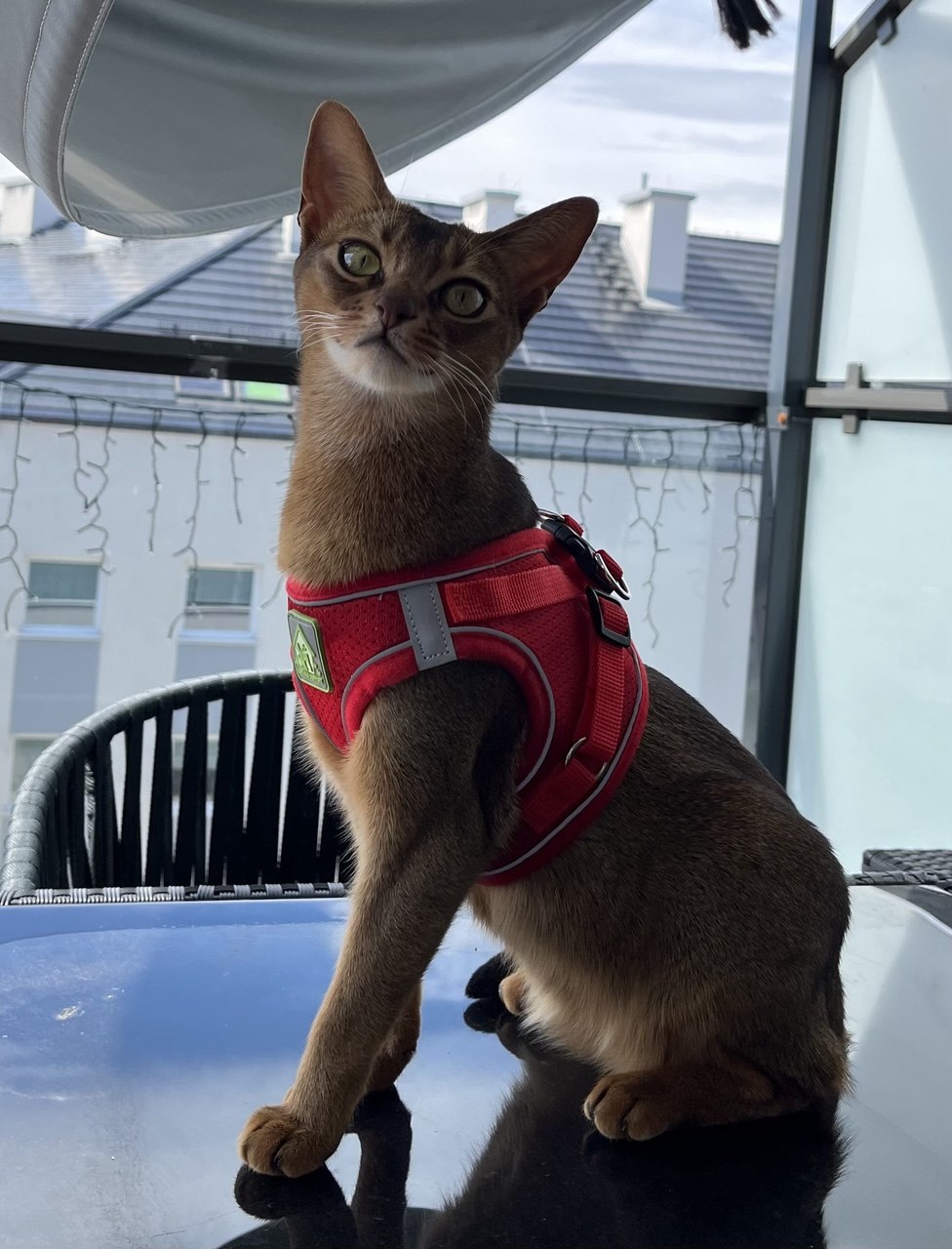
Most balcony cat enclosures are designed with an average domestic cat in mind: roughly 4 to 5 kilograms, standard adult dimensions, typical climbing and jumping behaviour. If you have a Maine Coon, a Ragdoll, a Norwegian Forest Cat, a Siberian, or any other large breed — or simply a particularly big individual of any breed — the standard assumptions do not fully apply to your cat.
The Breeds We Are Talking About
Large domestic cat breeds typically weigh between 6 and 12 kilograms for males, with females somewhat lighter. The most commonly owned large breeds include:
MAINE COON: The largest domestic breed. Males typically weigh 6–9kg, with some reaching 11–12kg. Long-bodied, muscular, excellent climbers. Known for their sociability and calm temperament, but physically substantial. RAGDOLL: Males typically 6–9kg. Less athletic than Maine Coons in temperament — Ragdolls are known for going limp when held — but physically large and with significant paw strength.
NORWEGIAN FOREST CAT: Males typically 6–9kg. Excellent climbers with specifically adapted paws for gripping. Descended from outdoor cats, they retain strong outdoor instincts even when kept inside. SIBERIAN: Males typically 6–8kg. Dense, muscular build. Strong jumping ability relative to body size. SAVANNAH (F2 and later generations): Varies considerably by generation. Large body, long limbs, and notably high jumping ability — some Savannahs can jump over two metres from a standing position.
BRITISH SHORTHAIR: Males typically 5–8kg. Stocky and heavy-boned rather than tall. Significant weight-to-size ratio. TURKISH VAN: Males typically 6–8kg. Known for their love of water and active outdoor behaviour. If your cat falls into any of these categories — or is simply a large individual regardless of breed — the following sections apply directly.
What Changes With Size: Load on the Enclosure
The primary concern with a large cat on a balcony enclosure is load. A 9kg Maine Coon jumping against a mesh panel generates significantly more force than a 4kg domestic shorthair doing the same thing. Force is mass multiplied by deceleration — when a cat lands on or impacts a surface, the deceleration is rapid, and the peak force is substantially higher than the static weight suggests. A 9kg cat jumping at moderate speed and stopping against a mesh panel is applying a dynamic force that could be three to five times its body weight at peak.
MESH MUST BE WELDED, NOT WOVEN: Woven mesh — including most chicken wire and many garden mesh products — has unfixed intersections that separate under sustained load. A large cat pressing repeatedly against woven mesh will open gaps at the intersections. Welded mesh has fixed, fused intersections that do not move. For large breeds, welded mesh is not optional.
FRAME MUST NOT FLEX UNDER LATERAL LOAD: A frame that flexes when you push it with your hands is a frame that will flex when a 9kg cat jumps into it repeatedly. Steel frames do not flex. Aluminium frames flex less than wood or PVC but more than steel. DIY PVC frames are not appropriate for large breeds.
Whatever your situation, the safest starting point is a custom steel window enclosure sized to your exact window.
ATTACHMENT POINTS MUST BE RATED FOR THE ACTUAL LOAD: If an enclosure states a 20kg load rating and your cat weighs 9kg, that sounds like adequate margin. But the stated load rating usually refers to static load, not dynamic load from impact. A 9kg cat hitting a panel at speed can generate peak forces that test a 20kg static rating. Look for products that are tested with dynamic load — actual impact testing, not just a weight placed on the frame.
The BalconyCat enclosure is rated to 40kg static load and tested at 70+ kg of dynamic human body weight — a deliberate choice specifically to address the large breed and multi-cat use case. This is not standard across all enclosure products. Check the specifications before purchasing, and ask directly if the listing is unclear.
What Changes With Size: Mesh Opening Dimensions
A large cat has a proportionally larger head, wider paw span, and greater ability to apply force to a specific point of a mesh panel. The standard 5×5cm mesh opening is appropriate for adult cats of average size. For very large breeds — Maine Coons and Norwegian Forest Cats in particular — the 5×5cm grid is the correct size. Their heads will not fit through a 5×5cm opening even at maximum adult size.
What 5×5cm mesh does not protect against with large breeds is paw entanglement. A large cat that hooks a paw into a mesh opening and pulls can exert significant force. This is not typically a safety issue in itself, but it accelerates wear on the mesh intersections — another reason welded mesh is important.
For kittens of large breeds: even a Maine Coon kitten at 12 weeks is smaller than an average adult domestic cat. During the kitten phase, 2.5×2.5cm mesh is the correct specification regardless of the adult size the kitten will eventually reach. A Maine Coon kitten’s head can absolutely fit through a 5×5cm opening before approximately 4 months of age.
What Changes With Size: Jumping Height and Distance
Large breeds — particularly Norwegian Forest Cats, Siberians, and Savannahs — have impressive jumping ability. A Savannah can clear over two metres from a standing position. A Norwegian Forest Cat can reach a two-metre shelf from the floor without effort. This changes the height requirement for any perimeter barrier or enclosure. A standard railing height of 90–100cm is easily cleared by a jumping large breed cat with motivation. An enclosure for a large breed must reach to the ceiling or roof of the enclosure — there can be no open top.
This is one of the arguments against side-only net systems for large breeds even on covered balconies. If a large breed cat can jump high enough to reach the point where the net meets the ceiling, and the ceiling attachment is a clip or hook rather than a fixed fitting, a sufficiently motivated cat can breach it.
What Changes With Size: Temperament and Outdoor Drive
Not all large breeds are the same temperamentally. Ragdolls, despite their size, are typically low-energy and not strongly motivated to escape — their famous “floppy” quality extends to outdoor behaviour. Maine Coons and Norwegian Forest Cats are more active and more curious, and are more likely to actively test an enclosure.
The physical size of the cat is therefore only part of the risk picture. A large, active, curious Norwegian Forest Cat on a high-floor balcony is a more demanding safety scenario than a large, calm Ragdoll on a second-floor balcony. Assess your specific cat’s behaviour honestly. If they actively seek outdoor access, test barriers, and show sustained interest in the enclosure edges — your enclosure needs to be built to the higher standard, regardless of how expensive or highly reviewed it is.
Practical Checklist for Large Breed Owners
Before allowing a large breed cat access to any balcony enclosure, confirm: the mesh is welded, not woven; the mesh size is appropriate (5×5cm for adults, 2.5×2.5cm for kittens under 4 months); the frame material does not flex under lateral load; the load rating is tested dynamically, not just static weight; the enclosure has a roof or top panel with no open top; and the frame passes a full physical test with your body weight on each panel and the frame joints.
Also observe your cat in the enclosure for the first week with attention to any sustained pressure points they favour. These are not excessive requirements. They are the correct baseline for any cat. For large breeds, they are non-negotiable.
If you have a large breed cat and are unsure whether a specific enclosure is appropriate — or if you want to discuss the 2.5×2.5cm kitten mesh option for a large breed kitten — get in touch.
get BalconyCat →