Is My Cat Safe on the Balcony? How to Know If Your Setup Is Actually Secure
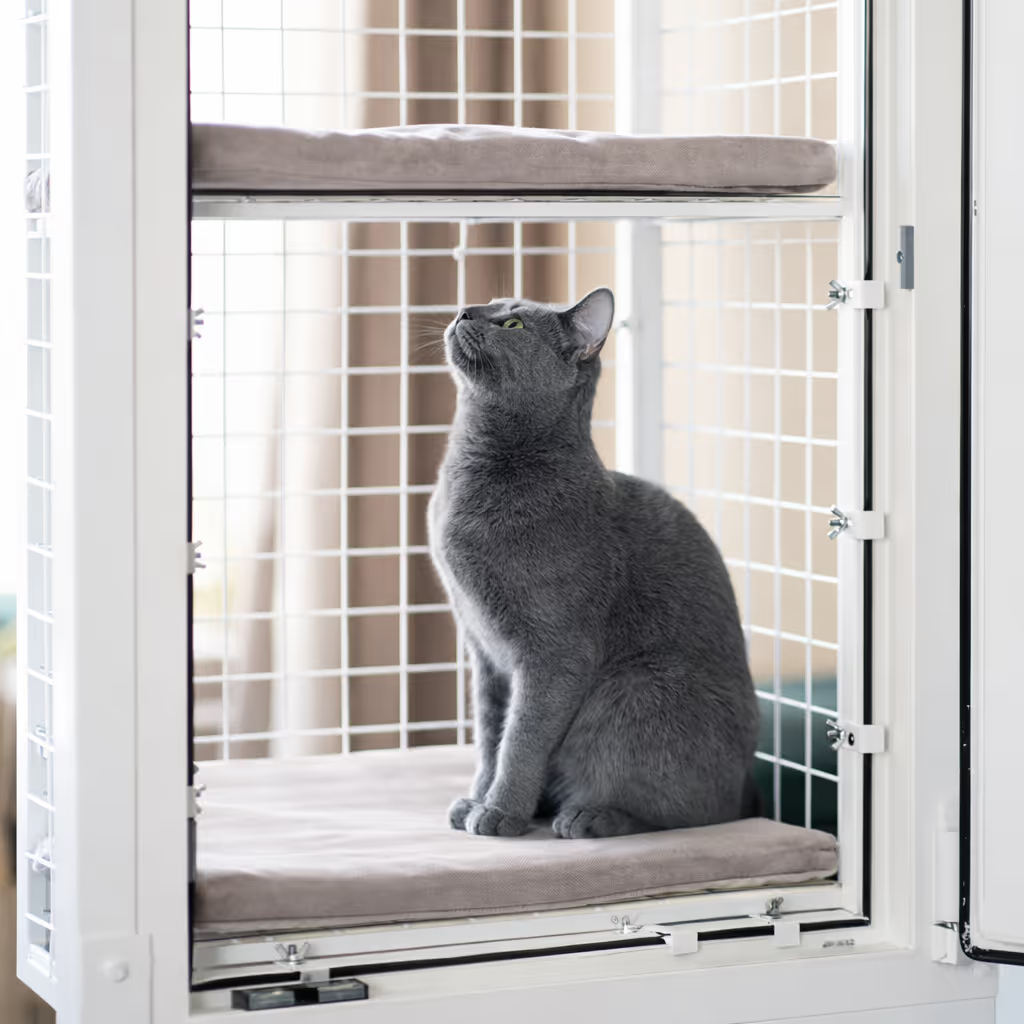
If you’re searching this, you probably already have some kind of balcony setup — and something is nagging at you. Maybe your cat pressed against the railing in a way that didn’t look comfortable. Maybe the net looks a bit tired. Maybe you just noticed how high you are and felt the familiar stomach drop. Whatever prompted the question, the honest answer matters. Here it is.
The Five-Point Assessment
Go out to your balcony and work through this. Be honest.
Point 1: The Gap Audit
Walk the full perimeter of your containment. Look for any gap larger than 5cm × 5cm — the size through which an adult cat can push their head. If their head fits, the rest follows. Common places gaps appear: corners where two net or panel sections meet; the top edge where the containment meets the ceiling or balcony above; along the railing where the net hangs away from the bar instead of lying flush; around attachment points where the material has pulled back from the fixing. Found any gaps? The containment has a structural problem. Your cat will find the same gap within days if they haven’t already.
Point 2: The Attachment Audit
Check every fixing point — every hook, clip, cable tie, or bracket that holds the containment in place. Is the fixing still in the position it was installed? Is the cable tie still under tension, or has it relaxed? Are adhesive fixings still firmly bonded, or do they flex when you push them? If you pull firmly on the net or panel section nearest the fixing, does the fixing hold without movement? Any fixing that moves, has shifted position, or has lost tension is a failure-in-progress. It will fail completely before you notice — probably on the day when your cat leans hard on that section.
Point 3: The Material Audit
For net systems specifically: hold a section up to the light. Does it look uniformly woven, or are there thin spots, frayed threads, or discoloured sections? Is the mesh rigid when you try to push your fingers through it, or does it deform easily? If the net is more than two years old and has been in direct sunlight, press your fingernail firmly against one of the strands. Does it feel brittle? Does it leave an impression that doesn’t spring back? UV-degraded netting looks fine until it doesn’t. The degradation happens in the polymer structure, invisible to casual inspection. The nail-press test is a rough but useful proxy for brittleness.
Point 4: The Height Assessment
What floor are you on? Be specific. Ground floor or first: a gap or attachment failure is serious but rarely fatal. You have more margin. Second through fourth: this is the danger zone in veterinary data — falls from these floors produce the most serious injury rates. Your containment needs to be in good condition. Fifth and above: the consequence of failure is severe. Net and modular panel systems are not adequate sole containment at these heights. If this is your situation and you are using a net, this post is the answer to your question: it is not safe enough.
Point 5: The Cat Audit
Watch your cat on the balcony for ten minutes. Lies down in the middle of the space and naps: lower active risk, their natural behaviour doesn’t involve sustained pressure on the containment perimeter. Paces the perimeter, sniffs at the railing, presses against the net or panels: higher active risk — they are actively investigating the boundaries, and a determined cat investigating a net will find every weakness. Attempts to climb: maximum risk. Any cat who climbs the containment is applying dynamic load and seeking an exit. Net systems are not appropriate for climbing cats.
What to Do With Your Assessment
NO ISSUES FOUND: everything solid, no gaps, no degradation, low floor, calm cat. Your setup is probably adequate. Recheck every six months. MINOR ISSUES (one or two cable ties loose, a small sag in one section): fix it this week. Don’t wait. Replace the cable tie, re-tension the section, fill the sag. Then recheck in a month. SIGNIFICANT ISSUES (multiple gaps, fraying material, attachment failures, high floor, climbing cat): this is not adequate containment. The answer to “is my cat safe on the balcony?” is: not reliably. You need a structural solution, not repairs to a failing system. FIFTH FLOOR+, ANY NET SYSTEM: the answer is no. The consequence of a net attachment failure at this height is not a recoverable situation. Replace the net system with a structural containment solution.
What a Structural Solution Looks Like
If your assessment has told you that your current setup isn’t adequate, the right next step is either: A) a rigid modular panel enclosure with a roof panel (more structural than netting, shorter lead time, lower cost); or B) a custom steel window enclosure (the most structurally sound option available for any floor, no-drill, custom-fitted to your window). For the fourth floor and below with a non-climbing cat: either is appropriate. For the fifth floor and above, or any cat who climbs or presses against containment: the custom steel window enclosure is the answer. It removes the net and attachment-point variables from the equation entirely.
Send us a description of your current setup, your floor, and your window type. We’ll tell you what we’d build and what it would cost. No commitment.