If you live in a city apartment with a cat and a balcony, this page is for you. It covers every relevant question — what the actual risks are, what the solutions look like, what depends on your floor, and how to navigate the specific constraints of apartment living: renting, landlords, small spaces, high floors.
The City Apartment Situation
Urban apartment cats are in a specific situation that house cats, suburban cats, and cats with garden access simply aren’t in. The balcony is often the only outdoor interface available. No garden. No catflap to a yard. No outdoor territory to patrol. The balcony — 2m × 3m of concrete outside the living room window — is all there is between your cat and the sensory deprivation of a completely indoor existence. This makes the balcony both more important and higher-stakes than for cats who have other outdoor options. Getting the apartment balcony right is worth spending time on.
What Makes Apartment Balconies Different from House Balconies
HEIGHT: apartment balconies are, almost by definition, higher than house balconies. Height changes the consequence of any containment failure. This is the central fact of apartment balcony cat safety. RENTING: the majority of city apartment dwellers in Europe rent. Renting means no drilling without landlord consent — which eliminates a significant portion of containment products on the market. Whatever you buy needs to be no-drill, fully removable, and leave zero damage. SMALL SPACES: urban apartment balconies are often very small. A 2m × 2m balcony in Berlin, Warsaw, Amsterdam, or Paris is not unusual. Containment products designed for generous outdoor spaces don’t always scale down without becoming intrusive. SHARED BUILDINGS: any balcony containment that is visually disruptive or structurally attached to shared building fabric may require landlord or building management approval.
The Floor-by-Floor Risk Assessment
GROUND FLOOR AND FIRST FLOOR: fall risk present but consequences usually non-fatal. Containment requirement: premium net or modular panel system adequate for most cats. SECOND THROUGH FOURTH FLOOR: significant fall risk. Falls from these floors produce serious injury at high rates in veterinary data. Containment requirement: structural containment required — net systems are not adequate as sole containment above the third floor. No-drill structural options required for renters. FIFTH FLOOR AND ABOVE: severe fall risk. No floor above the fifth should have uncontained balcony access for a cat. Containment requirement: maximum — welded steel enclosure, either window-mounted or full balcony. For renters: the window enclosure is the definitive no-drill structural option at this height.
The Renter’s Constraint in Detail
WHAT WORKS WITHOUT DRILLING: premium nylon net systems with hook-on or railing-clip attachment (adequate for low floors, calm cats); modular panel systems with railing-clip attachment (more structural, works for mid-floors); custom steel window enclosures with bracket mounting (no-drill, structural, works for any floor, fully removable). WHAT DOESN’T WORK WITHOUT DRILLING: timber-frame DIY builds (require wall fixings); most professional full-balcony enclosures (require structural attachment to building); any product using wall anchor fixings. The custom steel window enclosure is the only no-drill option that also provides structural containment confidence appropriate for high floors.
The Small Balcony Dimension
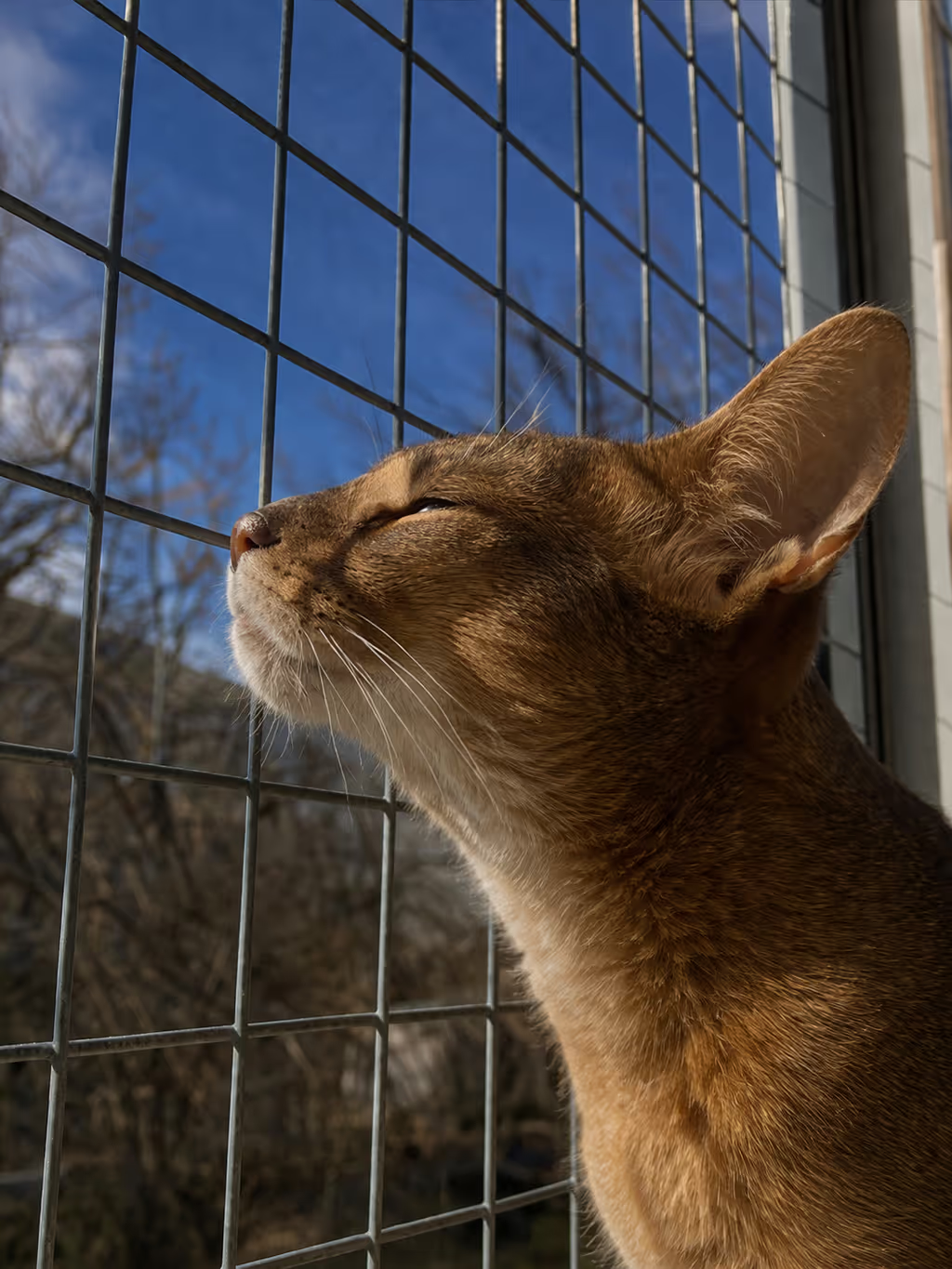
For balconies under 4m², a full balcony enclosure is often more intrusive than the space justifies. Enclosing a 2m × 2m balcony with sides and a roof creates a cage that dominates the visual space of the flat and removes human use of the balcony entirely. A window enclosure solves this differently. The cat gets outdoor access through the window — into a dedicated, structurally sound outdoor space at window level. The balcony floor remains as human territory. For small city apartments, this trade-off often strongly favours the window enclosure over the full balcony conversion.
The City-Specific Risks Most Guides Don’t Mention
URBAN BIRDS AND PREY DRIVE: city pigeons land on balcony railings and walk along window ledges. A cat who is otherwise calm will become highly aroused at close range with a pigeon. High prey drive arousal reduces the cat’s awareness of their position relative to the edge. Urban balconies have significantly higher bird activity near the structure than rural locations — intensifying the case for structural containment, because a cat lunging at a pigeon is applying dynamic force to whatever barrier exists. NOISE AND STARTLE RISK: city ambient noise includes sudden loud events — sirens, horns, fireworks. A cat startled by a sudden loud noise will bolt reflexively. Bolting on an open balcony is dangerous. Bolting in an enclosed catio or window enclosure is safe. HEAT ON HIGH FLOORS: high-floor south-facing balconies in direct sun can become very hot in summer. A cat contained in an outdoor enclosure must have access to shade. Restrict outdoor access during the hottest hours (12–15:00) in summer unless shade is provided within the enclosure.
The Complete Solution Checklist for Apartment Cat Owners
✓ Containment: structurally appropriate for your floor, no-drill if renting. ✓ Mesh size: 5×5 cm for adult cats, 2.5×2.5 cm for kittens under 4 months. ✓ Roof: included if cat climbs, included if above third floor, always safer than not. ✓ Load rating: documented, 25 kg minimum, 40 kg for high floors or athletic cats. ✓ Shade: available within the containment area for summer months. ✓ Water: accessible from within or adjacent to the enclosed space. ✓ No damage to property: fully removable installation, no drilling.
BalconyCat builds custom steel window enclosures for urban apartment cat owners. Custom-built from 899€. No drilling. Free delivery across Europe. We reply within 24 hours.
get BalconyCat →