Small balconies are the norm in most European apartment buildings. A 2m × 1.5m slab of concrete outside a living room window isn't much to work with — but it's still a balcony, and your cat still wants access to it. The challenge is that most catio products are designed for generous outdoor spaces. Here's what actually works.
Why Small Balconies Are Harder to Cat-Proof
The problem isn't the size of the cat. It's the ratio of edge to floor area. On a large balcony, the hazardous edge is a small proportion of the total space. On a small balcony, every point is close to the edge. A cat who turns around sharply, backs up, or misjudges a jump from the railing has very little margin before they're at risk. The entire perimeter of a 2m × 1.5m balcony is within one cat-jump of the open edge. This means you're not just trying to contain the perimeter — you're trying to make the whole space safe in a way that still leaves it usable.
What Cats Actually Use
Before deciding what fits, it’s worth understanding what your cat will actually use — because most cat owners overestimate the floor area their cat needs and underestimate the value of height and outlook.
Cats do not pace. They do not need room to run. What they want from an outdoor space is: a place to sit, fresh air, a view, and something to watch. A window sill with a breeze and a pigeon in sight occupies a cat completely. A large enclosed balcony with no view does not.
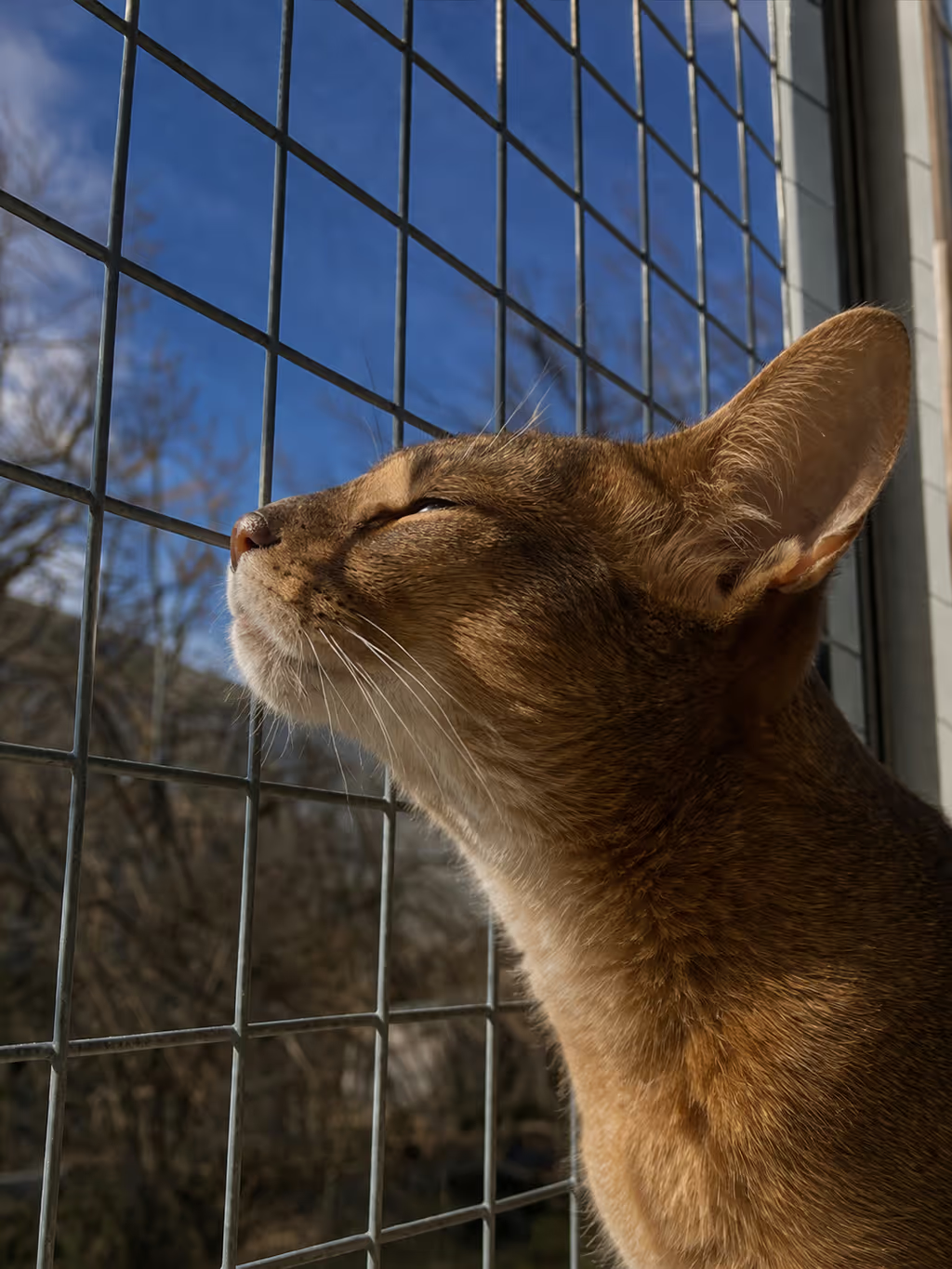
This means the size constraint of a small balcony matters far less than most people assume. A cat sitting in a steel enclosure extended from a window has exactly what it needs: height, fresh air, and an unobstructed view. The floor area is irrelevant.
What Doesn't Work on a Small Balcony
LARGE FREESTANDING CATIOS: The garden catio style — a walk-in cage on legs, often 2m × 2m or larger — simply doesn't fit a small balcony. Even if the dimensions were achievable, you'd be surrendering the entire balcony to the enclosure, leaving no space for human use. FULL BALCONY PANEL SYSTEMS: These enclose the full perimeter with sides and a roof. They work. But on a small balcony, they dominate the visual space completely — the balcony becomes entirely caged. You also lose easy access through the enclosure for watering plants, cleaning, or simply sitting outside yourself. For some owners this is fine. For others, having a 3m² cage where their balcony used to be is not the outcome they wanted.
What Does Work
Option 1: Partial Perimeter Net + Roof Panel
Rather than enclosing the entire balcony, fit a net to the open sides only (the sides that drop away from the building) and add a top net to prevent climbing over. This uses less material, is faster to install, and leaves the balcony feeling less enclosed. The limitation is that net systems have the attachment-failure and UV-degradation problems covered in other posts. On a small balcony at high altitude, those limitations matter more, not less. Suitable for: ground to third floor, calm adult cats, owners who want to preserve some balcony aesthetics.
The most reliable way to give your cat that outdoor space is a custom steel window enclosure that fits your window exactly — no drilling, and no gaps to slip through.
Option 2: Compact Modular Panel System
Some modular pet panel systems — sold in 60cm or 75cm panel widths — can be configured to enclose just the open face of a narrow balcony without consuming the whole space. If your balcony has one primary open side (which most small balconies do — open front, building wall on sides and back), a row of panels along the front face with a roof panel is a compact, effective solution. This is more structural than netting. The panels are rigid and can be anchored to the railing. Suitable for: any floor, any cat temperament, any tenancy (look for bracket-attached systems, not drilled ones).
Option 3: A Window Enclosure — The One Most People Miss
Here's the option most small-balcony owners don't consider: skip enclosing the balcony entirely and give the cat a window enclosure instead. A window catio mounts directly onto the window frame and extends outward — typically 40–60cm — at window sill level. The cat accesses it through the open window. It occupies zero balcony floor space. The balcony remains entirely usable by humans.
For a small balcony where floor space is the limiting factor, this often solves the actual problem more elegantly than any balcony enclosure. The cat gets safe outdoor access — fresh air, birds to watch, outdoor enrichment. The balcony stays yours. The caveat: it requires a casement window (one that swings open). If your balcony access is via a full-height sliding or hinged door with no casement window adjacent, this option doesn't directly apply. For most apartment layouts in European cities — where a casement window is standard and the balcony door is separate — the window enclosure is the cleanest solution for a small balcony.
How Small Is Too Small for a Window Enclosure?
There's no lower limit on window size that makes a window enclosure impossible — the enclosure is built to your measurements. We've made enclosures for narrow casement windows of 55cm width. The cat has a slightly smaller space, but they use it just as enthusiastically. The practical lower limit is around 50cm external frame width. Below that, the enclosure is functionally more of a perch platform than an enclosure — some cats love them, some don't get as much out of them. If your window is between 50cm and 80cm wide, talk to us before assuming it won't work. We've built for narrower openings than most people expect.
Which Option Should You Choose for Your Small Balcony?
Ask one question first: do you want to keep the balcony as human space, or are you happy for it to become entirely cat space? If happy to make it cat space: modular panel system on the open face + roof panel. Compact, structural, effective. If you want to keep the balcony as human space: window enclosure on an adjacent casement window. If budget is tight and the floor is low: partial perimeter net with roof panel. If you're above the fourth floor with any cat: the window enclosure is the correct answer. Small balconies on high floors make partial netting solutions higher-risk, not lower — the floor area gives you nowhere to retreat if the net fails.
The Bottom Line for Small Balcony Owners
A small balcony is not a barrier to giving your cat safe outdoor access. It just changes which solution is the right one. In most small balcony cases in urban apartments, the window enclosure is the solution that works best — takes no floor space, doesn't affect human use of the balcony, and gives the cat everything they actually want from outdoor access.
Frequently Asked Questions
Can I have a catio on a small balcony?
Yes. A window-mounted steel enclosure mounts to the window frame and extends outward, taking no balcony floor space at all. It is specifically suited to small balcony constraints.
What size catio fits a small balcony?
A window-mounted enclosure is custom-measured to your exact window, not your balcony size. It fits any standard casement window regardless of how much floor space the balcony has.
Will my cat actually use a small catio?
Yes. Cats don’t need large outdoor spaces — they need height, fresh air, and a view. A window enclosure provides all three. Floor area is not what cats seek from outdoor access.
Is a window catio better than a balcony catio for small spaces?
For small balconies, yes. A window catio uses no floor space, requires no drilling, fits any window precisely, and gives the cat everything it needs. A balcony enclosure kit will rarely fit a small balcony accurately.
How do I cat-proof a small balcony without drilling?
A window-mounted steel enclosure with bracket grips requires no drilling. It mounts to the window frame, leaves no marks, and is fully removable — making it the ideal solution for small rented balconies.
Custom-built to your measurements. From 899€. No drilling. We're ready to look at your window and tell you what we can build.
get BalconyCat →