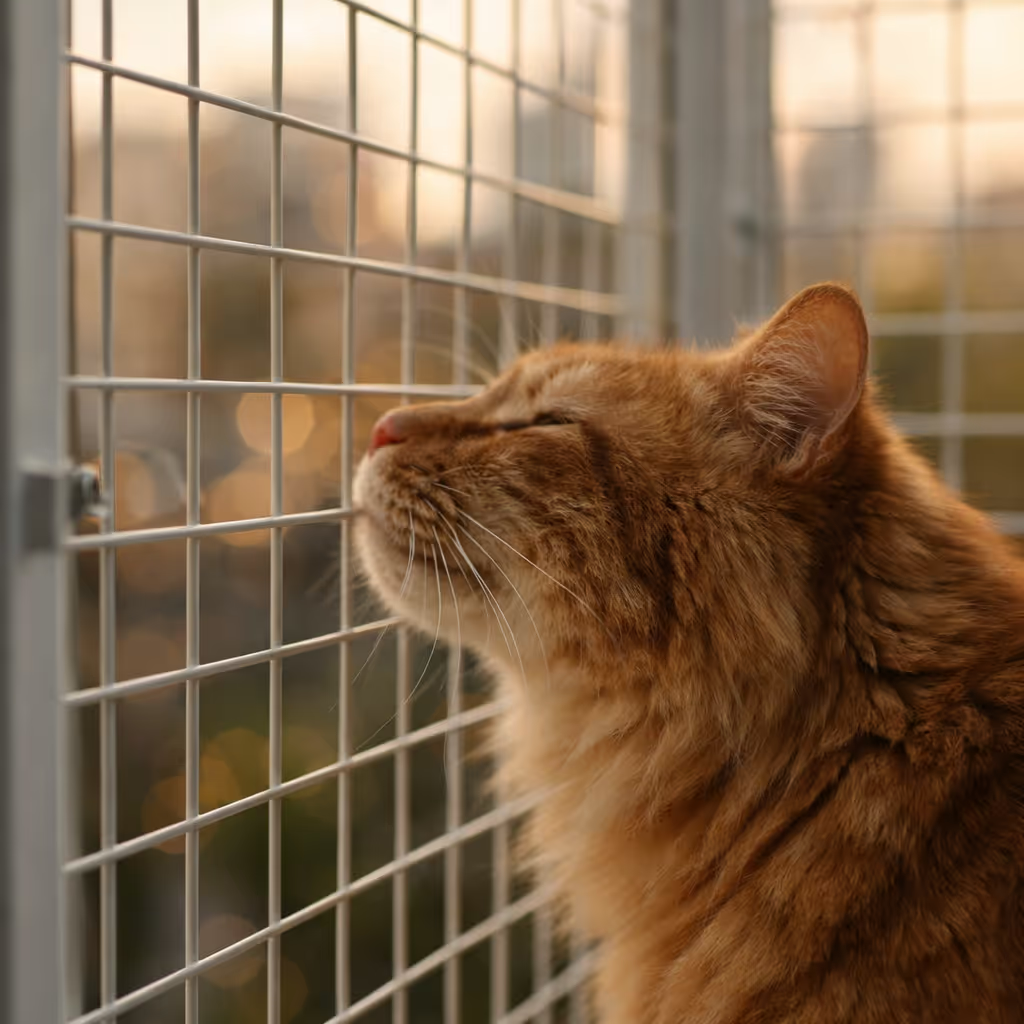
If you’ve been searching through balcony cat-proofing guides and finding that the advice doesn’t quite fit your situation — it’s probably because you have a deck or terrace, not a balcony. The products and approaches overlap, but the structural differences matter. This post covers cat-proofing specifically for decks and terraces: what’s different, which products work, and what to do about the railing type your deck most likely has.
How a Deck Is Different from a Balcony
HEIGHT: most decks are at ground level or raised by one step to one storey. A ground-level deck presents almost no fall injury risk — the concern is escape, not falling. A raised deck has a fall risk but lower than a fifth-floor balcony. This means the containment confidence level you need is lower for most deck situations than for high apartment balconies. PERIMETER SIZE: decks are often much larger than apartment balconies. A balcony might be 2m × 3m; a deck might be 4m × 6m or larger. Enclosing the full perimeter is a bigger project. RAILING TYPE: deck railings in houses are almost always different from apartment balcony railings — timber post and rail, composite decking rail, metal post and cable, or low timber balustrade. Almost all have significant gaps. Cable railings in particular can have 20–25cm between cables. ACCESS POINTS: a deck typically has multiple access points and often no natural boundary at ground level. A balcony is a contained platform; a deck may flow into a garden with no clear physical edge.
What Works for Deck Railings
Timber Post and Rail (Horizontal Rails, Large Gaps)
The most common deck railing in house gardens. Gaps between horizontal rails are typically 15–25cm — far too large. Fix options: infill netting on the interior face, stretched between top and bottom rails and fixed to each timber post with staples or cable ties (use UV-stabilised polyethylene netting for outdoor durability, recheck annually for timber movement); or rigid wire mesh panel infill, more structural, harder to install but longer-lasting. For both: the gate is always the weak point — address it separately with a dedicated mesh panel cut to fit.
Whatever your situation, the safest starting point is a custom steel window enclosure sized to your exact window.
Cable Railing (Horizontal Stainless Cables)
The hardest deck railing to cat-proof, for three reasons: gaps between cables are very large (20–25cm); cables are smooth with no attachment point for netting without specialist clips; horizontal cables function as a ladder. The most effective solution is a rigid mesh panel affixed to the interior posts — essentially bypassing the cables entirely and treating the posts as the structural attachment points. The mesh goes from floor level to at least 120cm (ideally to the overhead structure). More involved than timber railings but the only approach that properly addresses the cable gap problem.
Composite Decking Rail Systems and Low Timber Balustrades
Composite decking rail systems vary widely. Measure the gap first: if under 5cm, adult cats are unlikely to pass through and the main concern is the top edge. If over 5cm, infill required as described above. Low timber balustrades (under 80cm): a cat can clear 80cm in a standing jump — a low balustrade is essentially not a containment structure, it’s a platform to jump from. The solution is adding height: a full panel or net from the existing balustrade up to at least 120cm above ground, ideally with a top seal.
The Overhead Question on Decks
Most decks don’t have an overhead structure. This means that even if you seal the railing perfectly, a cat who can jump 120cm can potentially clear the railing and land in the garden beyond. Options: if the deck is small enough, a full top enclosure — essentially converting the deck into a catio (side panels and a roof); if the deck is too large for a full roof, a top rail overhang — a section of mesh angled inward at 45–60 degrees at the top of the perimeter (used in zoo enclosures for climbing animals for the same reason); if the cat is not a climber, focus on gap-sealing at railing level (not all cats will attempt to clear a well-sealed 120cm railing).
Window Enclosure as an Alternative for Deck Owners
If your deck is accessed from a room with casement windows, a window enclosure may be a more practical solution than cat-proofing the entire deck perimeter — particularly for large decks where perimeter enclosure would be a significant project. The cat gets safe outdoor access through the window. The deck remains as human space. You don’t need to enclose hundreds of square centimetres of railing. This is often the most cost-effective and structurally reliable outcome for house owners with large decks — the window enclosure solves the cat’s access need without the full deck perimeter project.
If you have a deck or terrace adjacent to casement windows, we’ll look at your photos and tell you honestly whether a window enclosure fits your situation — or whether a full perimeter approach is needed.
get BalconyCat →