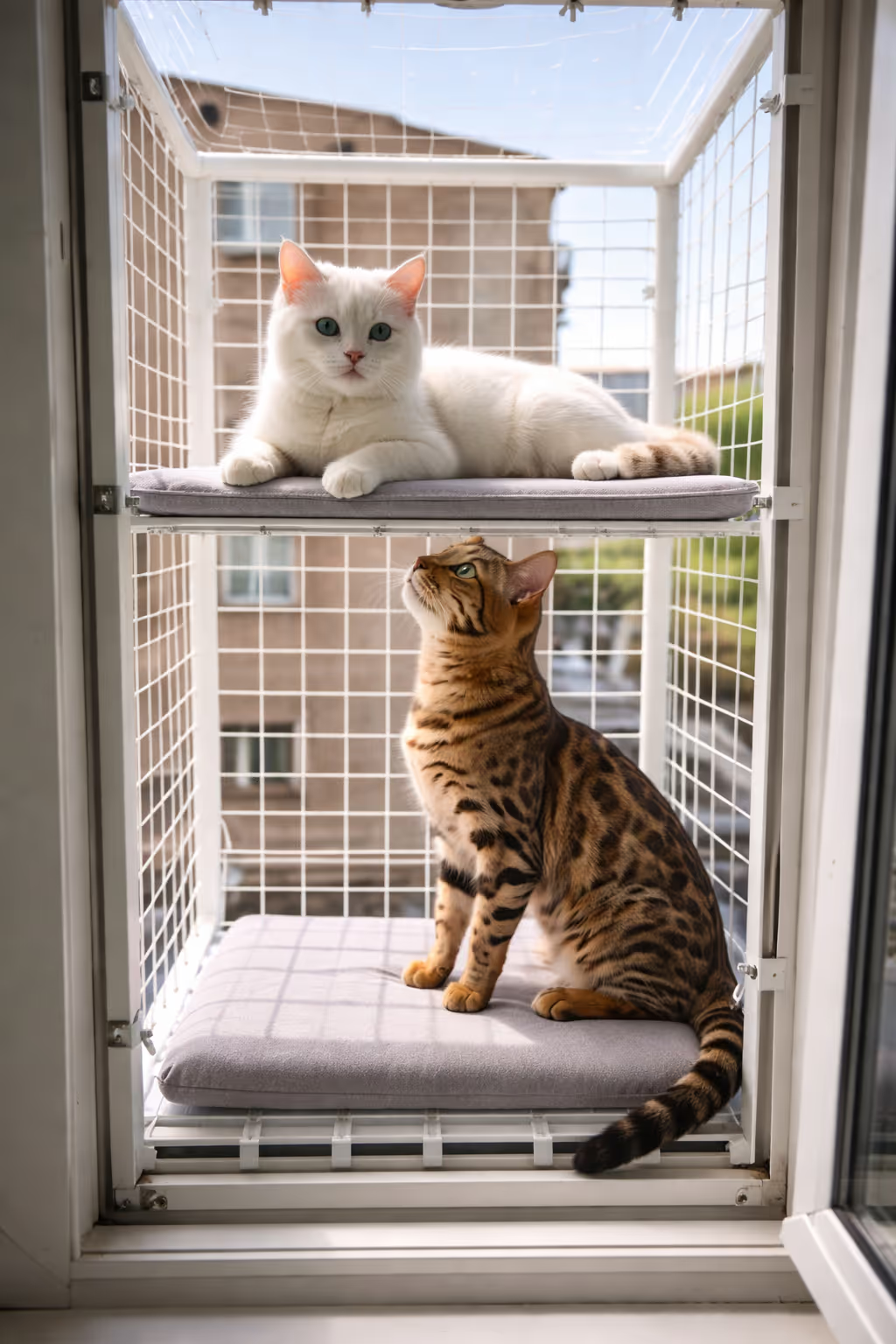
Indoor cats live longer, healthier lives than outdoor cats on average. What indoor cats do lack — and what most owners underestimate — is sensory and environmental variety. A balcony or window enclosure is one of the most effective enrichment additions available to an apartment cat owner. This article explains what it actually provides — specifically and honestly — and what it does not replace.
What Outdoor Access Actually Gives an Indoor Cat
When we say “enrichment,” we mean sensory and cognitive stimulation that engages a cat in ways that matter to its biology. Here is what a secured outdoor space delivers:
Changing Air and Scent
The indoor environment has a relatively constant scent profile. Outdoor air — even urban outdoor air — carries an enormous variety of scent information: other animals, plants, weather changes, food smells from neighbouring kitchens, seasonal variation. Cats process scent at a fundamentally different level of sophistication than humans do, and scent variety is a form of cognitive engagement. A cat sitting in a window enclosure with the window open is not just “getting some air.” It is processing an information-rich olfactory environment that is qualitatively different from anything available indoors.
Natural Light and Circadian Regulation
Indoor artificial light does not replicate the full spectrum or natural variation of daylight. Cats, like most mammals, have circadian rhythms that are regulated partly by light exposure. A cat with outdoor or near-outdoor light exposure has a more naturally regulated circadian rhythm, which affects sleep quality, appetite, and overall mood. A cat sitting in a window enclosure in direct morning sun is getting something that indoor light cannot fully replicate.
Auditory Variety
The outdoor soundscape is rich and unpredictable: birds, wind, distant traffic, rain on surfaces, the sounds of other people and animals. Indoor sound — even with TV or music — lacks the spontaneous unpredictability of natural outdoor sound. For a cat, unpredictable sound is interesting sound. A cat in a window enclosure during rain, listening to birds, or tracking a sound from below is cognitively engaged in a way that the interior of a flat rarely produces.
Visual Complexity and Movement
Moving targets — birds, leaves, people on the street below, clouds — engage the visual cortex and prey-drive circuitry in ways that static indoor environments do not. A cat that watches birds from a window enclosure is not idling. It is cognitively alert, tracking movement, making micro-assessments. The floor level of the window matters here. Lower floors with direct street view provide different visual complexity to higher floors with a skyline view. Both are enriching, but in different ways.
Whatever your situation, the safest starting point is a custom steel window enclosure sized to your exact window.
Temperature Variation
The indoor temperature in a modern flat is relatively constant. The outdoor environment varies across the day — cool morning air, warmer afternoon sun, the shift as the sun moves. Cats actively seek out temperature variation: the warm patch of sunlight, the cool shadow. A window enclosure that receives direct sun for part of the day gives a cat access to real warmth variation that indoor radiators do not replicate.
What It Does Not Replace
Being specific here matters. A window enclosure or balcony catio is not a substitute for everything that outdoor access provides. It is important to be honest about this.
SOCIAL INTERACTION WITH OTHER ANIMALS: A secured enclosure does not give your cat contact with other animals. Some indoor cats are genuinely stimulated by seeing and smelling other animals at a distance, but this is different from direct contact. If your cat is social and thrives on animal interaction, the outdoor enclosure supplements but does not replace other socialisation strategies — a second cat in the household, for example.
SELF-DIRECTED EXPLORATION AND TERRITORY: Outdoor cats range considerable distances. A window enclosure is a fixed point in space, not a territory to range. For cats with a strong exploratory drive, the enclosure is enriching but not a complete substitute for that drive. PHYSICAL EXERCISE: Sitting in a window enclosure is not exercise. It is rest in a stimulating environment. The physical exercise needs of an indoor cat should be met through active play sessions inside the flat — wand toys, chase games — not through the expectation that outdoor access provides exercise.
How Much Time in the Enclosure Is Beneficial?
There is no precise answer here, but the research on environmental enrichment suggests that even relatively brief periods of access to novel stimulation have meaningful behavioural benefits. Most behavioural recommendations for indoor cat enrichment suggest providing access to outdoor-adjacent environments for at least one to two hours per day. This does not need to be continuous — a morning hour and an evening session achieves the same benefit as two continuous hours.
The practical principle: the enclosure should be available when the cat chooses to use it, rather than only at scheduled times. A cat that has consistent access to the window enclosure and chooses when to use it gets more benefit than one that is put into the enclosure at a set time. If your window can be left safely open while you are home — with the enclosure as the outdoor boundary — that is the best configuration.
At night, close the window and the enclosure access. Nighttime outdoor environments are more active with urban wildlife, which can produce prey-state arousal in a cat that disrupts their sleep. Overnight indoor rest on a predictable schedule is part of good circadian regulation.
Combining the Enclosure with Indoor Enrichment
The outdoor enclosure works best as part of a broader enrichment approach, not as the sole intervention:
FORAGING AND FOOD ENRICHMENT: Feed part of your cat’s daily food allocation through puzzle feeders, scatter feeding, or food hidden around the flat. This engages the hunting and problem-solving behaviour that a cat’s brain is built for.
ACTIVE PLAY: Two or three ten-minute wand toy or chase sessions per day provides the physical engagement that the enclosure does not. These sessions also strengthen your bond with the cat, which is itself a form of enrichment.
VERTICAL SPACE INDOORS: A tall cat tree, shelving at various heights, or a clear pathway across high surfaces gives your cat vertical territory to explore and occupy inside the flat.
THE ENCLOSURE: Reliable access to fresh air, natural light, scent variety, and the visual complexity of the outdoor world — for one to two hours each day, consistently. Together, these four elements address the primary enrichment deficits of indoor life for most cats. The outdoor enclosure is the one element that cannot be replicated by anything else — no indoor substitute provides real outdoor air, real birdsong, real sunlight, and real outdoor scent variation.
If you are thinking about adding a window enclosure or balcony solution to your indoor cat’s life and want to understand what the right setup looks like for your home — we are happy to help.
get BalconyCat →