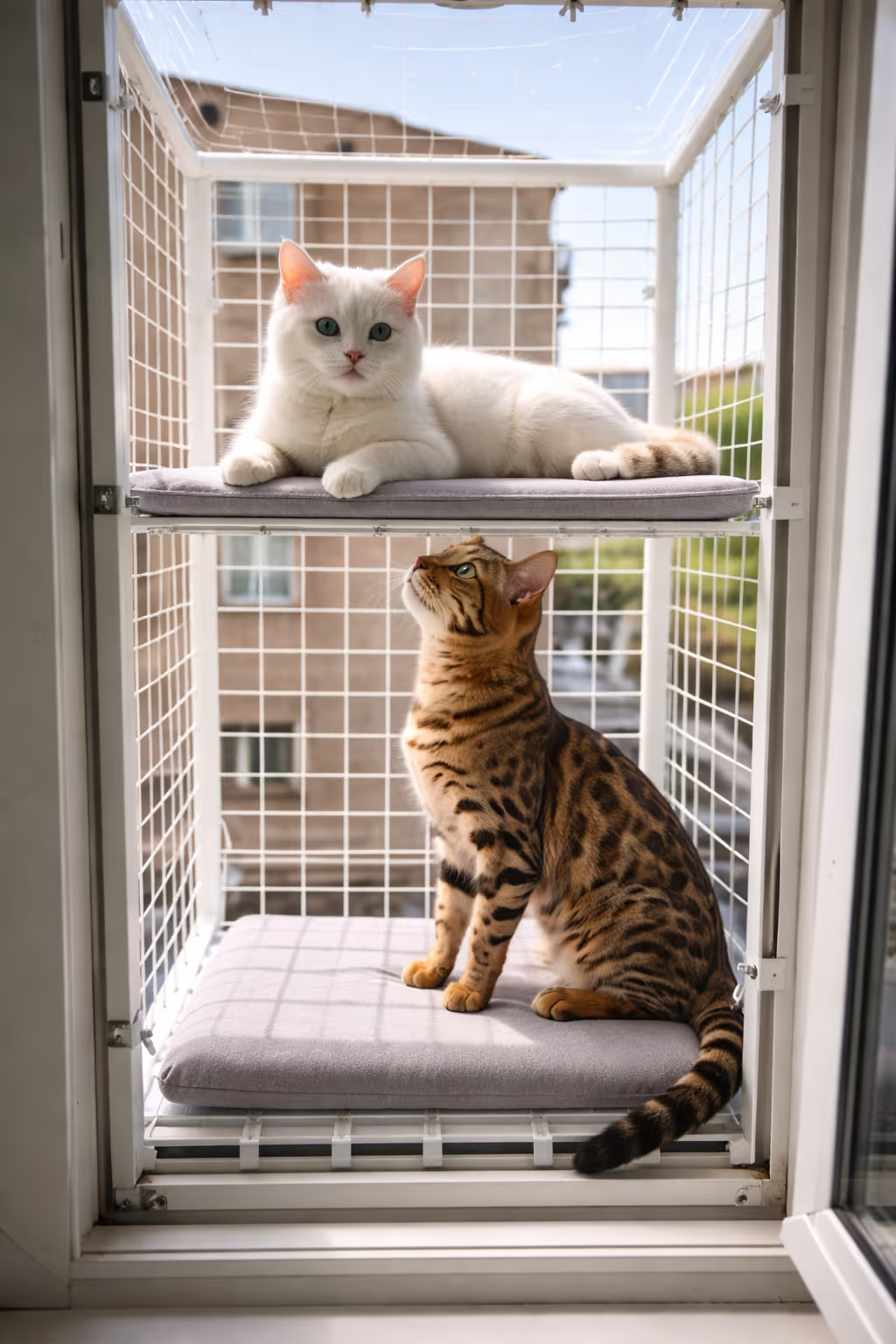
If you’re searching for a “balcony cover for cats,” you’ve probably already realised that most balcony safety products don’t address the top. They seal the sides. They leave the roof open. And a cat who can climb — which is most cats, given enough motivation — will find that gap within days. This post covers what a covered balcony enclosure looks like, when you need one, and what options actually exist.
Do You Need a Roof?
The short answer: if your cat climbs anything, yes. YOU NEED A ROOF IF: your cat has ever climbed a door frame, bookshelf, or any vertical surface indoors (any cat who climbs indoors will climb the sides of a balcony enclosure, and will find the top of a 180cm net enclosure within the first week); your balcony railing is lower than 120cm (most cats can clear 120cm in a standing jump); your cat is under 3 years old (young cats are more athletic, exploratory, and risk-taking around enclosure perimeters); you’re above the third floor (at height, the consequence of a roof failure is not recoverable — a roof is cheap insurance). YOU MAY NOT NEED A ROOF IF: your cat is 8+ years old, genuinely non-athletic, and has never shown interest in climbing; your balcony sides are 180cm or higher; or your cat has physical limitations that reduce jumping capacity. Even in these cases, a roof adds essentially no disadvantage. If you can add it easily, add it.
What “Balcony Cover” Products Actually Exist
Option 1: Add-On Top Panel for Existing Enclosures
If you already have a net or modular panel enclosure on your balcony sides, the simplest option is adding a top panel. For net systems: a horizontal net panel stretched across the top, fixed to the wall on one side and to the top of the perimeter net on the other. What to check: tension decreases toward the centre of a large top panel. Fix at every 40–50cm, not just at corners. For modular panel systems: most good panel systems sell dedicated rigid roof panels. Confirm the roof panel is included or available before purchasing the side panels. Cost for add-on top panel: 30€–120€.
If you're unsure whether an open top is safe, a fully enclosed steel window enclosure settles it — there's simply nothing for the cat to climb over.
Option 2: Complete Covered Enclosure System
Products that include both side panels and a roof in one integrated purchase. Cleaner because the structural connections between sides and roof are part of the design, not an afterthought. What to look for: rigid panel connections between sides and roof (not net-to-panel connections, which are always the weak junction); frame material aluminium or steel (plastic frames distort under load); roof panel mesh size consistent with side panel mesh. Cost: 150€–450€ for a complete covered modular enclosure.
Option 3: Custom Steel Window Enclosure (Inherently Covered)
This is the option that makes the roof question disappear entirely. A window catio is a closed structure. It has six sides — front, back, two sides, top, and bottom. There is no open top. There is no roof panel to add. The enclosure is complete by design. The cat enters through the open window, sits in the enclosed steel cage, and has no exit path. Not through the mesh. Not over the top. Not through a corner gap. For any cat whose climbing behaviour makes a roof necessary, the window enclosure is the cleanest answer — because it was never open at the top in the first place. Cost: from 899€, custom-built, welded steel, no drilling.
What About Weather? Does a Roof Mean Rain on the Cat?
Open steel or wire mesh doesn’t stop rain. Your cat will feel rain through a mesh roof the same way they’d feel it through the sides. In practice, cats are extremely good at knowing when weather is coming and self-regulating their outdoor time accordingly. Most cats will come inside when rain starts — before you’ve even noticed it’s raining. If you want a weatherproof overhead cover rather than a mesh roof: a solid polycarbonate or clear acrylic panel replacing the mesh roof section (keeps rain off while letting light through); or a removable outdoor fabric cover over the mesh roof (used in wet weather, removed in good weather). Neither is standard across balcony cat products but both can be improvised or custom-ordered.
The Installation Point Most People Miss
The junction between the roof panel and the sides is the most structurally critical point in any covered enclosure. This is where the greatest forces act — a cat jumping at the roof or hanging from the connection point — and where most failures begin. Whether you’re using net, modular panels, or a rigid system: fix the roof-to-sides connection at every available point, not just corners; check these connections after the first week of use as cats apply load to new containment structures as they explore; tighten or reinforce anything that shows movement.
The BalconyCat window enclosure is a closed structure — no roof question, no top panel to add, no junction to worry about. Built to your window, from welded steel, shipped flat-packed.
get BalconyCat →